
A review by Pauline Flannery for EXTRA! EXTRA!
Bauhaus: Art as Life
B. Bauhaus: Art as Life (3 May – 12 August 2012)
Photo by: Jane Hobson 2012
Barbican Art Gallery
3 May – 12 August 2012
Forged over fourteen years, 1919 – 1933, the Bauhaus movement embraced art, science and technology. Its philosophy: ‘a change for the better’ in the wake of WW1. Founded by architect Walter Gropius, its architectural legacy endures a negative backlash – soulless, sterile – yet its influence is everywhere from schools, offices, hotels to housing in glass fronts, geometric clean lines and functionality.
On the Barbican’s lower level, is a series of blown-up, sepia photographs which seem to enforce this idea: a solitary figure eats, deep in thought, in an otherwise empty canteen. Alongside it is an image of a communal hall with row upon row of empty seats. Yet the Bauhaus movement is much more than this.
B. Bauhaus: Art as Life (3 May – 12 August 2012)
Photo by: Jane Hobson 2012
The thirty year old Barbican Arts Centre - double the Bauhaus’ years in maturity – brings together over 400 works from the three Bauhaus phases: Weimar, Dessau and Berlin. In this high profile cultural, as well as Olympiad, year, this singular exhibition inhabits a purpose-built installation space, providing a mise en scene in Bauhaus black, grey and steel, in keeping with its spirit. It’s like stepping into a Huf Haus…..
Ten key progressions, such as ‘salute to the square’, ‘our play, our part, our work’, ‘stage, space, architecture’ and ‘designing the modern world,’ tell the Bauhaus story. Yet the breadth and range of the work is uppermost, in a constant interplay between idea, expression and execution. In a dazzling display of craftsmanship covering sculpture, painting, textiles and photography - the work of over a hundred creators - everything underpins the exhibition strapline ‘art as life’ yet at times this could read the other way round, particularly in the thematic thread of the Bauhaus at play…..
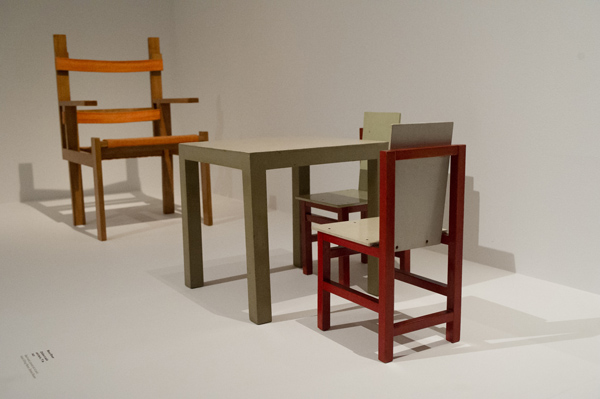
Photo by: Jane Hobson 2012
Back in 1919, Gropius gathered together practitioners who disseminated ideas through experimentation and intellectual debate, including artists Wassily Kandinsky and Paul Klee. The iconographic Haus am Horn, sounding very like house and home, built for the Weimar Bauhaus exhibition of 1923, was designed by Georg Muche, Adolf Meyer and Walter Gropius. It aimed at ‘the greatest comfort with the greatest economy by the application of the best craftsmanship and the best distribution of space in form, size and articulation.’ This could serve as an anthem for Bauhaus itself. In 1996, the Haus am Horn was declared a 20th century world heritage site.
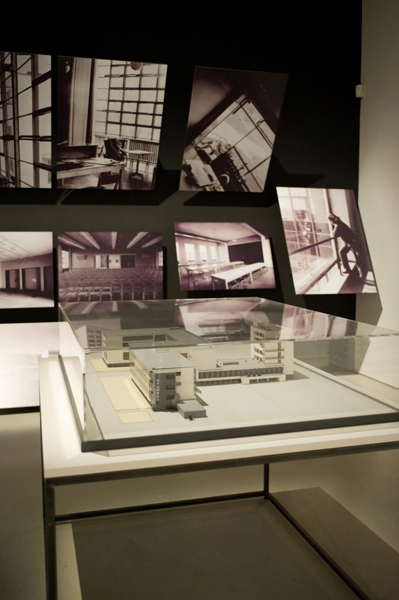
Photo by: Jane Hobson 2012
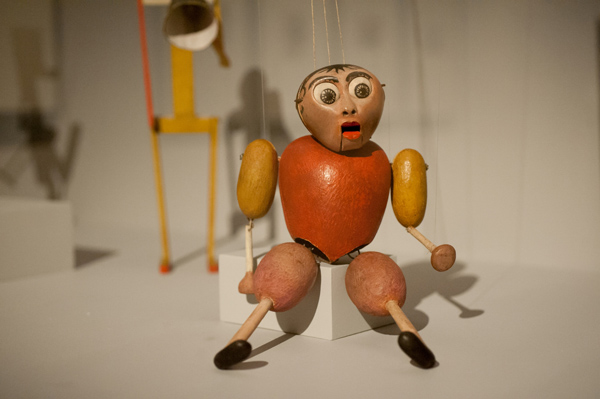
I was drawn to the obvious theatrical elements of the exhibition: the black and white gelatin prints of Lucia Moholy Performance on the Baushaus Stage and Balance Studies, 1924, echoed in the huge figurines and children’s toys, in Oskar Schlemmer’s Bauhaus Dancers, Dance with Forms, 1926; and in the small but exquisite Mary in the Moon or Moon Play, 1923, lithograph on cardboard.
The School’s ambition, in its middle years, to unite the arts links to the creative ideas of another Weimar veteran, composer Richard Wagner. Expressed through the stage workshop and its director, Oskar Schlemmer - ‘an art of space and movement’ - he called it, there is an air of theatricality about everything that the Bauhaus did at this time.
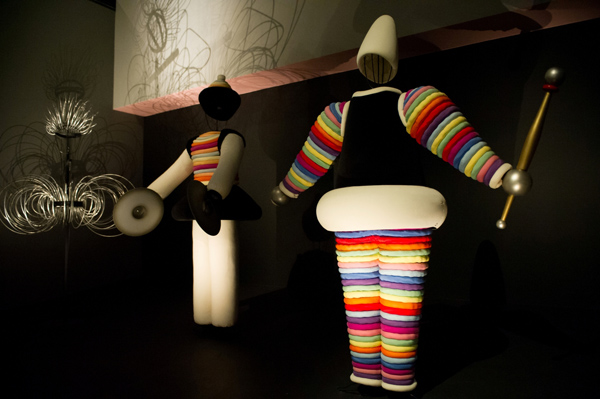
Photo by: Jane Hobson 2012
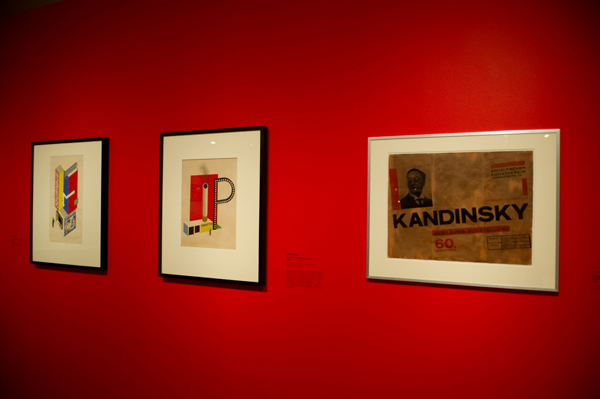
Within a year of the move to Dessau, in 1925, the infamous, rectilinear, curtain-walled new premises, in glass and steel, was built, and Michael Breuer’s iconic tubular steel chair, 1925-6, inspired by the bicycle, became the world’s first flat pack. Grand design was everywhere from a newspaper stand, cigarette pavilion, Herbert Buyer’s poster celebrating Kandinsky’s 60th birthday, 1926, to the textiles of Anni Albers and Gunta Stolzl’s exuberant 5 Choirs, 1928, recalling Paul Klee.
By 1929, Advertising was split into typography, printing and photography; resulting in the startling Mouth Series, 1931 - a precursor to Andy Warhol’s experiments in block printing - by Kurt Kranz, and the lone figure of Otti Berger in the canteen on the day before the Bauhaus closure in 1933…So many stories: artistic, political, pragmatic, aesthetic.
Throughout, the geometric shapes of the circle, triangle and square dominate, ensuring that any subsequent expression, will owe something subliminally or otherwise, to this prolific school. After its closure in 1933, its teachers and students, like the Hydra, spawned new organisations built on Bauhaus principles, on a global scale…as vibrant, as timeless now as it was back in the 1920s and early 1930s.
Bauhaus is a very, very, very fine house…A very fine house indeed….
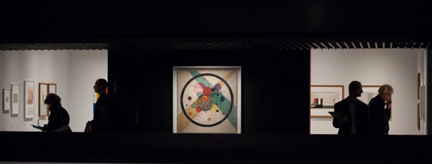
Photo by: Jane Hobson 2012
Barbican Centre
Silk Street
London
EC2Y 8DS
0845 120 7550
Barbican.org.uk/artgallery
11am – 8pm, Wed 11am – 6pm, every Thurs LATE until 10pm
Tickets: Standard £10 online/£12 on the door, Concessions £7 online/£8 on the door
Secondary School (groups of 10 or more) £6, under 12s free
Red members: unlimited free entry for member + guest
Orange members: unlimited free entry for member
Yellow members: 30% off which is £7 online/£8.40 on the door
Copyright © EXTRA! EXTRA All rights reserved