
A review by Pauline Flannery for EXTRA! EXTRA!
Everything Was Moving: Photography from the 60's and 70's
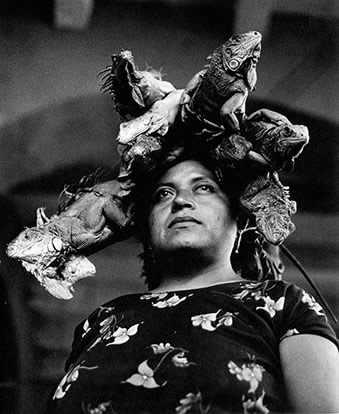
Graciela Iturbide's Our Lady of the Iguanas, Juchitan, Mexico, 1979
Barbican Art Gallery
13 September 2012 - 13 January 2013
Everything was moving: Photography from the 60’s and 70’s is described as a ‘personal landscape.’ it might be more accurate to describe it as ’global territories,’ for it brings together twelve photographers whose subject matter ranges from America’s Deep South to South Africa’s mines, from China’s red square to Latin America’s Sonora Desert, from the Russian Sandwich Transparencies of Boris Mikhailov to the Ganges Modernism of Raghubri Singh.
Yet in an otherwise fantastic exhibition, there is one omission: the acknowledgement of John Szarkowski, curator of MOMA, New York, 1967, which shifted photography from pragmatics to aesthetics in a ground-breaking exhibition called New Documents, featuring the work of Diane Arbus, Lee Friedlander and Garry Winogrand. That said, this timely exhibition at the Barbican‘tells a history of photography through the photography of history.’
Set over two levels, the exhibition brings together over 400 works: such as Bruce Davidson’s Time of Change 1961 – 1966, featuring the freedom riders from Montgomery, Alabama, to Jackson, Mississippi or Li Zhensheng’s striking, black and white, panoramic images of The Mourning of Mao. Most striking are the photographs of Ernest Cole, a black South African photographer who as an exile in New York produced the House of Bondage, in 1967.
Cole’s white compatriot, David Goldblatt, with his broody cityscapes, groups of miners and disenfranchised communities detail different narratives: Arriving Family Groups, 1955, Funeral of 58, 1969, Wedding Party, 1970. He plays with symmetry, dualities in black and white compositions to create heightened detail, such as the interplay between the flow of white cars going one way set against a pedestrian swarm of black workers going in the other in Evening Exodus, 1964. Or the overhead shot of The Maid’s Room, 1969, in which the textured candlewick bedspread is the only luxury, next to a newspaper headline which reads, ‘Moon Men on the Way Back.’ Or the deliberate contrast of a horse butchered in a field, surrounded by the littered carcasses of clapped out cars and trucks.
William Eggleston’s early 5 x 7 stunning headshots are ‘transformed by a sense of heightened near hallucinatory perception.’ In full colour, they pre-empt his own ‘deep south’ series in which forgotten landscapes, film headlines or spare hotels end in a room with a ‘red ceiling,’ with plaster cracks, a single light, crackling static, and danger. The photographs are provocative, lush, vivid in colour, and suggest film-maker, David Lynch.
Indian artist Raghubir Singh, also experimented with colour and juxtaposition to show an India full of energy and contradiction. Singh captures in Pilgrim and Ambassador, Prayag, Uttar Pradesh, 1977, with its blue sky, exotic Eastern canopy and red automobile, an uneasy alignment between east and west. Its vibrant red colouring links it to William Eggleston’s ‘red ceiling,’ yet contrasts to Singh’s own Catching the Breeze, 1975, with its joyous freedom as two sisters swing high amongst the trees.
Latin American, Graciela Iturbide is known for her studies of the nomadic Seri people of the Sonora Desert. Yet in her Panama City Series 1971, the arresting black and white images of Angel Woman, Sonora Desert, 1979, or in our veneration to Our Lady of Iguanas, 1979, Iturbide captures an abstraction, which is off-beat and quirky, which she completes in The Framed Man, 1973, and Sponge Vendor, 1974.
This same provocative irony is in Russian Boris Mikhailov’s Yesterday’s Sandwich/Superimpositions, bold in size, sensuality and colour. The absurd juxtapositions recall Dali or Monty Python, yet they lead just as naturally to Larry Burrows’ huge, colour, Vietnam compositions, Malik Sidibe’s playful I am crazy for records, 1973, and Sigmar Pokle’s stark mono-chromed world.
Everything Was Moving: Photography from the 60s and the 70s, offers the chance to contrast and compare ‘photography’s.’ John Szarkowski likened photography to ‘a growth.’ In 1967 it came of age on a global stage where rights, freedoms and identities were re-drawn. Photography filled the space: from the physical mines in South Africa to the intellectual square of Mao’s influence. Photography captured a moment to signify many.
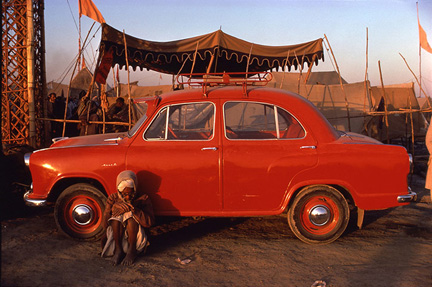
Raghubir Singh's Pilgrim and Ambassador Car, northern India, 1977
Barbican Art Gallery
http://www.barbican.org.uk/artgallery/event-detail.asp?ID=13613
Barbican Centre
Silk Street
London EC2Y 8DS
Box Office & Membership: 020 7638 8891 (10am-8pm Mon-Sat , 11am-8pm Sun)
Standard: £10 online/ £12 on the door
Concessions: £7 online/ £8 on the door
School groups of 10 or more (primary, secondary and sixth form up to age 19): £6
13 - 17s yrs: £6 online/ £7 on the door
Children aged 12 and under: Free
Barbican Members
Red Members: Unlimited free entry + guest
Orange Members: Unlimited free entry
Yellow Members: 30% off for you + guest
Art Gallery Opening Hours
Open daily 11am – 8pm, except Wed 11am – 6pm
Open late every Thu 11am – 10pm
Copyright (c) EXTRA! EXTRA! All Rights Reserved