- Home
- Latest Reviews
- Archive
- Reviewers
- Press
- Previews
- Creative Projects
- Links

A review by Pauline Flannery for EXTRA! EXTRA!
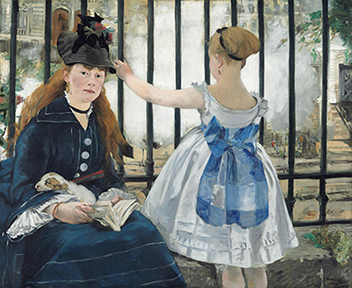
Edouard Manet
The Railway, 1873
Oil on canvas
93.3 x 111.5 cm
National Gallery of Art, Washington, Gift of Horace Havemeyer in memory of his mother, Louisine W. Havemeyer, 1956.10.1
Photo courtesy of the National Gallery of Art, Washington
‘He is himself. He paints what he sees, as he sees it, and he sees it truly’…Ernst Hache, 1869
Manet: Portraying Life at the Royal Academy is a series of interlocking secrecies: is his work portraiture or genre painting? Is he Chocolate-Box King or inspired modernist? And who is Leon – son, godson or brother? This exhibition curated by Mary Anne Stevens and Dr Larry Nichols offers a comprehensive overview. What follows is an extraordinary range of work from 1862 to 1882, encompassing the ‘cultural portrait’ of the Music in the Tuileries,1862, the heightened consciousness of Fishing,1863, the carefree fluidity of the cigar-smoking critic and poet Stephane Mallerme, 1876 and the dominance of the Morisot paintings of the 1870s.
While it is tempting to place this chronology in terms of Manet’s developing artistry from Rue d’ Amsterdam to Rue d’ St Petersburg, his preference for close family and friends as models is more revealing. His wife Susanne, teacher-musician and admirer of Wagner and Schumann, dominates in the first instance. She is seen in rather doughty form at the piano, in the garden or in repose. These portraits are deceptive. The energetic brushwork in this last painting, Woman with Cat, 1880, juxtaposes flecks of blue and red to the old rose pink of the dress.
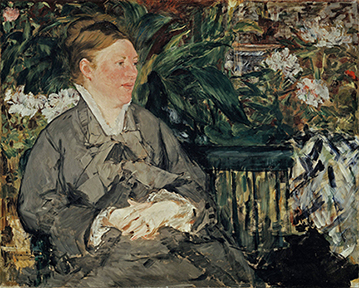
Edouard Manet
Mme Manet in the Conservatory, 1879
Oil on canvas
81 x 100 cm
The National Museum of Art, Architecture and Design, Oslo
Photo Borre Hostland
It is this attention-drawing, yet contrasting detail,which unifies his work; evident in the translucence of the girl’s bow against the grey smoke from the steam trains in The Railway, 1873, through to the starched white collar and cuff and formal black suit in Portrait of Henry Rochefort, 1881. Yet the vibrancy in the Berthe Morisot paintings – in mourning or with a bouquet of flowers – painted in the mid-70s belongs uniquely to them. These paintings are different. Morisot is strictly muse-only. She is seen in head and shoulder shots, in revealing blocks of paint in light and shade.
‘I cannot do anything without a model,’ he said, yet Manet created effective mise en scene from his studio, shown in Emile Zola, 1868, complete with screen, cluttered desk top, Japanese print and woodblock drawing, and in the deceptive simplicity of The Promenade Mm Gamby, 1880, with the figure painted against lush, verdant foliage. There is an interesting contradiction here. Firmly of the realist set Manet embraces the theatricality of early portraiture with its symbols of status and wealth and then he turns this on its head. Similarly, his fondness for theatricality finds echoes in the striking black riding habit of The Amazon, 1880, and in his portrait of exotic opera singer the Algerian Emilee Abre, as Carmen, 1880, in her highly decorated shawl. The transference between portraiture and genre is the spirit in Manet’s work. This transition, sometimes within the same painting, holds the attention.
The enigmatic Victorine Meurent, with her Titian-red hair, figures in Street Singer, 1862 and as the nude model for Dejeuner surl’herbe, 1863, Manet’s modern pastoral which scandalised its viewing public, and finally in The Railway, 1873. The figures of the young woman and the child in this last painting dominate, yet one faces us while the other looks across the tracks at the Gare Saint-Lazare, Paris, towards Manet’s newly acquired studio in Rue d’ St Petersburg. The pictorial ambivalence is complete.
Manet: Portraying Life brings together his paintings from over the world. Some of its secrecies it retains, the paternity of Leon, for example, others speak through a different language in paint - his intimacy with Berthe Morisot, while others reveal the modernist artist learning from the old masters to strike out firmly, and uniquely, on his own…
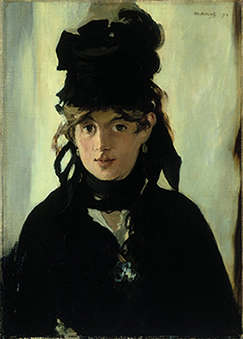
Edouard Manet
Berthe Morisot with a Bouquet of Violets, 1872
Oil on canvas, 55.5 x 40.5 cm
Musee d Orsay, Paris
Copyright © EXTRA! EXTRA All rights reserved