
A review by Pauline Flannery for EXTRA! EXTRA!
Picasso and Modern British Art
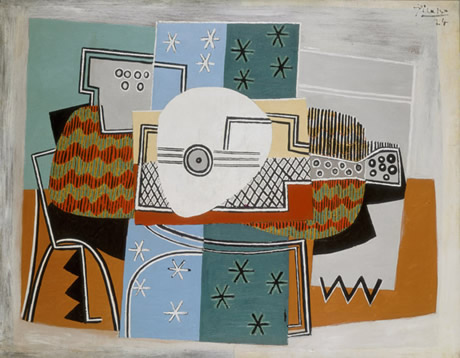
Pablo Picasso - Guitar, Compote Dish and Grapes, 1924
Collection Stedelijk Museum Amsterdam
© Succession Picasso / DACS 2011
Tate Britain
15 February – 15 July 2012
In a room of its own hangs Picasso’s The Three Dancers, 1925. He regarded it as one of his greatest achievements. It stands as the final exhibit, drawing together the multi-layered strands in a major exhibition Picasso and Modern British Art atTate Britain. With its brooding black figure to the right, its central cruciform dancer and jazz dancer to the left, the thematic threads of dance, death and suffering are played out.
Picasso and Modern British Art explores his significant output, his influence on British art, and his many life-long connections, including Diagliev, Gertrude Stein, and of course, at the forefront of the British Avant Garde, the Bloomsbury set. When Picasso’s work was first exhibited in 1910, it drew a bemused, sometimes caustic response - GK Chesterton likened one of his works to ink spilt on paper which the artist had tried to dry off with his boots.
Yet over a hundred years later these twelve rooms offer gem after gem. The spine of the exhibition is structured around Picasso’s four visits to Britain, featuring the highly influential 1919 visit when he worked on the scenery and costumes for Diaghilev’s Ballet Russe Company. It forms a retrospective of sorts, with over sixty original Picassos, including the iconic Weeping Woman, 1937. The most stunning section is Picasso in Britain 1920 – 1939 with work ranging from 1901 to 1937.
Picasso said that ‘the war is in all my paintings’. Here the subject matter is foregrounded in the visceral bold markings of his characteristic cubist lines, use of colour and shape - all in a kind of artistic anarchy. Wyndham Lewis was too precipitate when he criticised Picasso for having no artistic energy in his work. Lewis himself experimented with his own form of ‘geometric abstraction’ in his urban landscapes, which his friend Ezra Pound, coined Vorticism.
With the benefit of hindsight, one of the most striking aspects of Picasso’s work is an energy which is fresh and communicative, from Jars and Lemons, 1904, bought for £4 - which is directly referenced by Duncan Grant’s Design for a Firescreen, 1912 - to the dominant Standing Nude, 1928, featuring Picasso’s female biomorphic figures.
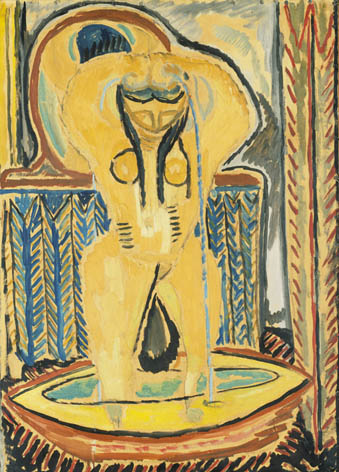
Duncan Grant - The Tub circa 1913
Tate. Presented by the Trustees of the Chantrey Bequest 1965
© Estate of Duncan Grant. All rights reserved, DACS 2011
Picasso’s early experimentations with impressionism from 1901, in particular The Race Course at Auteuil or Blue Roofs, Paris, are revelatory. From 1909-10 hangs Cubist Head (Portrait of Fernande) - and just when you wonder where the transitional bridge is - you encounter Female Nude with Arms Raised, 1907, a work later referenced by Henry Moore in Woman with Upraised Arms, 1924-5.
The most satisfying segue is from bold Wyndham Lewis and his striking, theatrical pictures, such as the Theatre Manager, 1909, in reference to Picasso’s association with Diagliev and the Ballet Russe. Set designs for The Three Cornered Hat, sketches for the drop curtain and the actual costumes for the legendary dancers Tamara Karsavina and Leonide Massine, prove his involvement; he even helped with the dancers’ maquillage. There is a real sense of life, in stark contrast to his other reflective works from the war years.
The British artists who have the most painterly association with him are Graham Sutherland and Ben Nicolson. His biomorphic pieces link directly to the sculptor Henry Moore. The most reverential is David Hockney. The Paint Trolley, 1985, a photographic collage, is a witty homage to Picasso featuring paint, brushes, canvas, with Christian Zevos’s legendary catalogue of Picasso’s output, at its centre.

Ben Nicholson - 1933 (coin and musical instruments), 1933
The Metropolitan Museum of Art , New York
© Angela Verren Taunt 2011. All rights reserved, DACS
Picasso’s Guernica is a strong reference point for Sutherland, particularly the image of the screaming mother with dead child. Sutherland, commissioned to record bomb damage, and a Roman Catholic convert, recalls Picasso in a series of crucifixion pictures. As does Francis Bacon’s triptych Three Studies for Figures at the Base of a Crucifixion, 1944, and his Crucifixion series, 1933.
Picasso and Modern British Art is inspired and inspiring. The British artists are made the richer for Picasso’s association, yet each has moulded his influence to his own purpose. Picasso lived and worked through extraordinary times. Antony Blunt described Minotauromachy, 1935, as ‘the nightmare of a great artist reflecting the instability of the time.’ Yet this is not all the story. In The Three Dancers, 1925, with its triumvirate of death, war and dance you see the man.
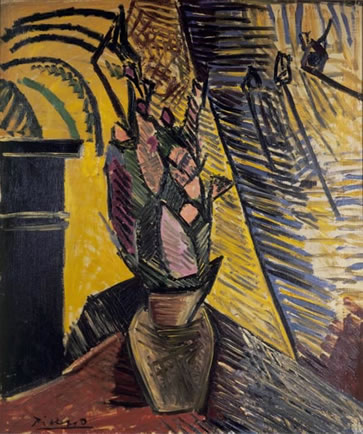
Pablo Picasso - Vase of Flowers, 1908
Museum of Modern Art, New York
© Succession Picasso / DACS 2011
Tate Britain
Millbank
London SW1P 4RG
020 7887 8888
visiting.britain@tate.org.uk
Open 10.00–18.00, Saturday–Thursday
10.00–22.00, every Friday
Last admission to exhibitions 17.15 (Friday 21.15)
Late at Tate Britain on the first Friday of each month
Copyright © EXTRA! EXTRA All rights reserved