|
Radical Nature
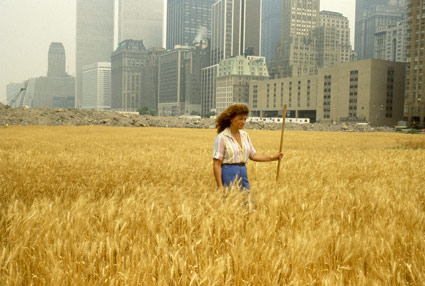
Agnes Dene – Wheatfield – A Confrontation, 1982 Photograph: (c) Agnes Dene Courtesy the artist
19 June – 18 October 2009
A review by Mary Couzens for EXTRA! EXTRA!
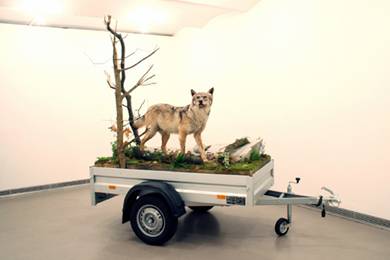
To place Mark Dion’s Wilderness Unit – Wolf (2006) in the pivotal opening position of this exhibition which professes to focus on ‘the relationship between art and nature’ while also being ‘the first exhibition to bring together key figures across different generations who have created utopian works and inspiring solutions for our ever-changing planet’ is a contradiction in terms, possibly a deliberate one. While Dion’s probable point that in contemporary times we often run the risk of turning nature into ‘an available commodity’ is a valid one, this conceptual piece, featuring the carcass of an animal is decidedly paradoxical. While all of life could be viewed in that way, this exhibition might have done better to feature the work of one less known in the contemporary art world and more respected in the present day ecological one for its opening.
Mark Dion – Mobile Wilderness Unit – Wolf, 2006 Courtesy Georg Kargl Fine Arts, Vienna Photo: Lisa Rastl
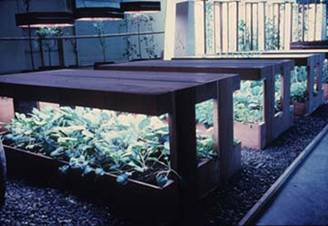
Newton Harrison and Helen Mayer Harrison - Full Farm, 1972 View of Flat Pastures Courtesy the artists
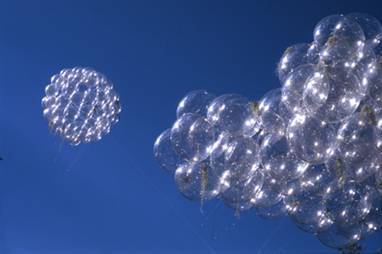
Tomas Saraceno Flying Garden (detail), 2006 Courtesy the artist and Banakdar Gallery, New York
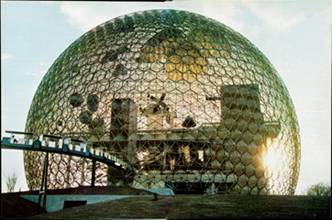
The late American visionary, Robert Buckminster Fuller’s theory of the ‘goedesic dome’ as explained by him in the film, Modelling Universe (1976) claimed that there are ‘only three structural systems in the universe’; the short film, which is being shown continually in a wooden igloo shaped hut in the exhibition, representative of his theories, explains how ‘nature inspired his work and attitude towards life.’
Richard Buckminster Fuller - US Pavilion for Expo 67, 1967 Commissioned by the US Information Agency for the Montreal World’s Fair Courtesy of The Estate of R. Buckminster Fuller
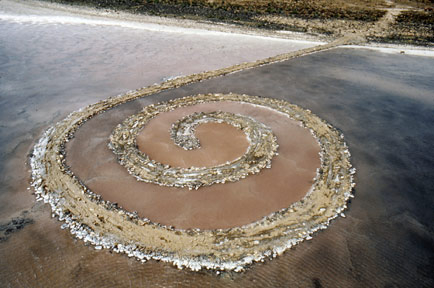
Robert Smithson represents the Land Art form via the 1970 film Spiral Jetty which details his mammoth ‘Earth-work’ in Utah of the same name. But one cannot help but wonder at the ecological friendliness of such a large scale outdoor work and the power extended to build it.
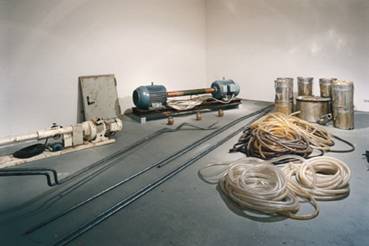
Honey Pump at the Workplace, Joseph Beuys 1977 Louisiana Museum of Modern Art Humlebaek, Denmark (c) DACS, 2009 Photo: Struwing Foto
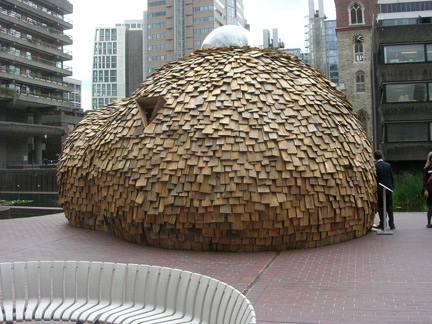
Even though it seems like a simplistic concept, as a realised project, Agnes Denes’ Wheatfield – A Confrontation (1982) for which 2 acres of wheat were planted and harvested on Battery Park landfill in New York City in the shadow of the World Trade towers was striking, not just because of its close proximity to such an iconic landmark, but for its political and economic implications following eras of scandal surrounding the stockpiling of wheat and other crops in order to intentionally drive market prices up. According to the exhibition’s creator, Francesco Manacorda, a similar field is being planted in Dalston, East London on a disused railway line, though it would no doubt make much more of a political statement if it were planted (and harvested) a bit closer to Parliament. Luke Fowler’s film Bogman Palmjaguar (2007) about a man from the so-called Flow Country in the Northeast of Scotland makes some valid points. Despite the man’s commendable interest in preserving the natural habitat of the surrounding ancient bog, or perhaps, because of it, Bogman Bluequartz Palmjaguar is diagnosed by the NHS as being paranoid schizophrenic. The Blur Building (2002) by Swiss collective Diller Scofidio and Renfro is a film showing their ‘lightweight support construction’ above Lake Neuchatel shrouded in fine white mist pumped from the lake water with people ‘disappearing’ as they make their way down the long, tubular bridge like structure. According to their bio, the collective’s work seeks to ‘reconsider conventional distinctions between nature and artifice.’ Finally, Heather and Tom Morrison’s outdoor wooden work, ‘I am so sorry. Goodbye’ is a consummate piece of craftsmanship with its swirling, ramped interior, triangular windows, overlapping air-allowing slats and domed, bubble roof, the latter of which, is, according to the artists, a futuristic reference point. This structural artwork has been partly inspired by ‘1970’s U.S. West coast utopian communities,’ i.e. communes, and with its web of joined triangular shapes, it is also reflective of the scientific theories of the aforementioned Buckminster Fuller. Having gone inside of this Lakeside structure, I can confirm that it is just as fine a piece of work inside as out with its rough hewn tables and seats and triangular windows, each of which seems to be aligned with a different natural or architectural feature of the Barbican’s exterior: reeds on the water, fountains, water-lilies, or, a large square window of the Barbican itself. ‘I am so sorry. Goodbye’ will, for the duration of this exhibition, be serving as a tea room where exhibition visitors will be served hibiscus tea and then told, ‘I am so sorry. Goodbye’ at the door, a phrase suggestive of language barriers.
Heather & Ivan Morison. I am sorry Goodbye, 2008 Originally commissioned for tattan park Biennial 2008 Photo by John Couzens
(c) EXTRA! EXTRA!
The premises of this non-chronological exhibition promise to probe some very topical themes and concerns which are actually broached through some of its artworks, though without following through to the point of offering potential viable solutions to any of the world’s environmental problems. It must be said however, that for some of the artists who were working during the earlier days of the exhibition’s timeframe, environmental issues may not have been uppermost in their minds, as climate change and other related issues are even now, relatively new concerns in the forefront of the public’s consciousness. That said, Radical Nature at least presents an opportunity to view work that might generate more serious discussion related to potential solutions.
Great Salt Lake,Utah Image courtesy James Cohan Gallery New York Photo by Gianfranco Gorgoni
Barbican Art Gallery
Open daily 11am – 8pm
Copyright © EXTRA! EXTRA All rights reserved
|