Art

A review by Barry Grantham w for EXTRA! EXTRA!
WATTEAU: THE DRAWINGS
The Royal Academy of Arts
12 March to 5 June 2011
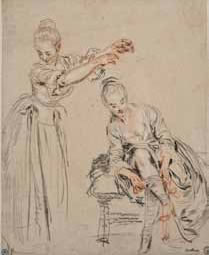
Two Studies of Women, the One on the Left with Arms Raised, the One on the Right Seated, Pulling up Her Stocking
c. 1716–17
Black, red and white chalks and graphite on cream paper, 260 x 205 mm.
Nationalmuseum, Stockholm
Photo © The Nationalmuseum, Stockholm
ESPIRIT & VERITE: Watteau and his circle
The Wallace Collection
12 March 5th June 2011
I entered the first gallery of the exhibition in the Sackler wing at the Academy with my actor’s eyes alert for representations of predecessors in my trade: Watteau is renowned for his pictures of actors and the characters of the Commedia dell’Arte. In fact a dozen or less, of some ninety drawing on exhibit depict performers, but as I proceeded. – looking ever closer, my focus changed and I became aware of the sheer beauty of the objects before me, so that they, and not the things they represented became the object of my attention. However from a historical view the theatrical element in Watteau is not without interest. For example, there are echoes of the Commedia dell’Arte to be seen in the only pornographic drawing on view – an exquisite reclining nude with attendant maidservant. As one looks on admiringly, only gradually does one become aware that the maid is holding a large enema syringe. – a favourite device of the Commedia dell’Arte, which Dr Graziano would bring out when the improvised comedy was failing. Another, is a portrait of a Persian gentleman – and for once, a portrait it seems. In the Commedia the Eastern potentate, usually referred to as The Turk is frequently brought into the scenario to express the strange and exotic. So the question is, is this a real Persian or once again one of Watteau’s friends in fancy costume? Mr Pierre Rosenberg, a former director of the Louvre, at the press viewing informed us that there was a Persian delegation in Paris at about the time of the drawing.
This brings us to the whole question of Watteau’s Commedia dell’Arte pictures and to study this, one should take a brisk walk up Bond Street from the RA to Manchester Square. There, at the Wallace Collection is a complimentary exhibition which includes many of Watteau’s most famous paintings. Here is Mezzetino – well, it’s not the actor Costantini but a picture dealer, Sirois . And the Pierrot – known as Gilles, looks as if he had stage fright – I’m not trying to devalue them as works of art – though I don’t think the paintings reach the genius achieved in his drawings – they’re just not as theatrical as are those by Jaques Callot or Watteau’s master Claude Gillot.
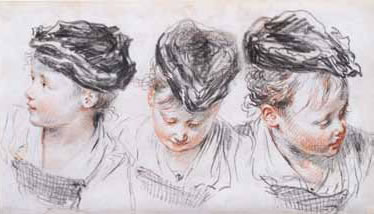
Three Studies of a Young Girl Wearing a Hat, c. 1716
Red and black chalk, graphite on paper, 138 x 246 mm.
Collection of Ann and Gordon Getty
This is probably accounted for by the fact that the Italian players, having offended the King’s mistress, Mme de Maintenon, were dismissed and banned from Paris in 1697 and.Watteau didn’t get to Paris until 1705. It is said that in Gillot’s studio there was a wardrobe of Commedia costumes which Watteau was to draw upon. (unintentional pun). Now though I suggest that Watteau was not directly influenced by the Commedia dell’Arte that had just preceded him – he was to influence the coming French theatre {as he influenced dress design) by his exquisite refinement, his dreamlike quality, his elegance, imparting that particular atmosphere to be found, for example, in the great French mimes from Deburau to Marceau
The Exhibition at the Royal Academy, is a rare opportunity, in fact one unlikely to be repeated, to view some of the world’s most important drawings. And the Wallace have collected into one gallery, their own and some borrowed masterpieces. They also present a major showing devoted to Jean de Jullienne, publisher of the Watteau engravings and his principal dealer. This last has yet to receive my attention..
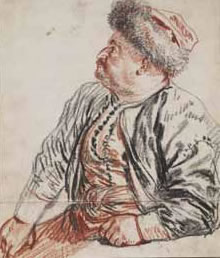
Seated Persian Wearing a Fur Hat, 1715.
Red and black chalk on paper, 250 x 212 mm.
Teylers Museum, Haarlem
WATTEAU: THE DRAWINGS
12 March to 5 June 2011
The Royal Academy of Arts
Burlington House, Piccadilly
Admission: £12 Concessions £10 Children £8
Tickets: 0844 209 0051
www.royalacademy,org.uk
ESPIRIT & VERITE:
Watteau and his circle
12 March 5 June 2011
The Wallace Collection
Manchester Square
Admission Free
Open 10am -5pm
0207 563 9500
www.wallacecollection.org.uk
Copyright © EXTRA! EXTRA All rights reserved