|
Reviewers
Sara Westrop, Ben Monks and Will Young for
Supporting Wall
in association with Neil McPherson for the Finborough Theatre
and supported by
Old Vic New Voices
present
Blue Heaven
Three short plays by Tennessee Williams
Mooney’s Kid Don’t Cry
Auto-Da-Fe
This Property is Condemned
Directed by Abigail Graham
with
Charlotte Beaumont
Alex Beckett
Victoria Boreham
Oliver Coopersmith
Tricia Kelly
Ben Porter
Finborough Theatre
In rep. 8 – 23 February, 2009
 ary Couzens ary Couzens
A review by Mary Couzens for EXTRA! EXTRA!
This trio of rarely performed one act two -handers written by Tennessee Williams in the 1940’s, and set during the Great Depression era of the 1930’s is fascinating for a number of reasons, not the least of which, its intimations to the major plays which would become so revered later on in his career: The Glass Menagerie (1945 - New York Circle Drama Critics Award), A Streetcar Named Desire (1948 – Pulitzer Prize for Drama), The Rose Tattoo (1952 – Tony Award - Best Play) Cat on a Hot Tin Roof (1955 – Pulitzer Prize for Drama), Night of the Iguana (1961 – New York Circle Drama Critics Award), and many others. For in these early one act plays, are the inklings of archetypal characters to come: Cat on a Hot Tin Roof’s Maggie (‘the Cat’) in red silk dress and curls, as remembered by the man who fathers Jane child in Mooney’s Kid Don’t Cry, The Glass Menagerie’s fiercely Southern mother Amanda Wingfield and a neurotically repressed version of her son Tom in Auto-Da-Fe, a youthful Blanche Du Bois and her trusting would be paramour Mitch in This Property is Condemned. As such, Blue Heaven might also provide inspiration to writers who find themselves working on characters or scenarios that ‘just aren’t there yet,’ over and over again and are tempted to quit.
Mooney’s Kid Don’t Cry finds wild haired, overall clad Mooney ruing the day he got ‘caught’ by Jane, the mother of their infant child. His lamentations about life at ‘the plant’ under his gossipy Dutch boss are neatly interspersed with dreamy remembrances about his time spent in Ontario, out in the open, chopping down trees, while Jane cites more urgently practical issues like ‘wet diapers’ and their lack of money. As is always the case with Williams work, the ending still comes as a surprise to the audience, even though it is one we all recognise as being akin to the dynamics of our own lives. Such are the incomparable observational skills and ability to get those dynamics across inherent to Williams’ writing.
Although the writing tends to take centre stage during the performances of Williams’ plays, Alex Beckett holds his own as Mooney, enacting convincing renditions of Williams’ near soliloquies as the alternatingly happy and raging young father. There are also some memorable moments here between Beckett and Victoria Boreham as Jane, particularly during Mooney’s remembrances of her in all her femme fatale glory at the dance-hall he met her in ten months before.
Auto-Da-Fe, a term alluding to public penances common to the Spanish Inquisition, finds Mme. Duvenet and her frantic son Eloi metaphorically entombed in a run-down house in a down at heel parish in New Orleans. Eloi’s otherwise, mundane world has been rocked by the unexpected appearance of a dirty picture during one of his robotic workdays at the post office. As he already views his neighbourhood as the epitome of sin and the people living in it as perpetrators of evil, the emotional backlash the appearance of the photo creates in him is on the surface, intolerable, but in reality, unbearable. In contrast, Eloi’s Mother, with whom he lives, remains proudly unemotional.
Ben Porter does a fine turn as Eloi, whose agitation escalates physically as well as emotionally as he ‘confesses’ the source of this latest outrage to his stone-faced mother. The source of his repression is further highlighted in one scene in which his mother, Mme. Duvenet, played with take charge efficiency and firm self-righteousness by Trish Kelly, attempts to cure one of her son’s recurrent headaches with an Oedipal embrace. Mme. Duvenet has established herself as family matriarch despite the fact that Eloi is her only offspring and thus sole recipient of her back-handed mothering.
.
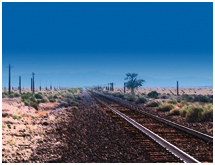
The final play, This Property is Condemned, focuses on two adolescents who meet up by chance along a Mississippi railroad track. At first glance, it seems as though Willie, wonderfully portrayed by Charlotte Beaumont, who began her acting career at the age of five with Blag Youth Theatre, is playing dress up in her dishevelled blue satin dress and exaggerated lipstick. However, as the play progresses and her counterfoil Tom, who has skived off school because he thought the wind might be just right for flying kites, appears, we learn the shocking truth – Willie has been abandoned. Her mother has run off with one of the railroad men, her father subsequently walked out and the older sister she emulates has died. And, as Willie points out, ‘dyin’ ain’t like it is in the movies’, an observation she bases on the fact that in Greta Garbo’s death scene in Camile, she was surrounded not only by white flowers and violins, but by beaus.
Oliver Coppersmith’s measured performance as Tom suggests a more stable familial background with his line of questioning, which seems to stem from normally boyish curiosity, all of which only serves to make Willie’s life alone in the condemned property which was her former home seem all the more tragic. However, the real tragedy of this storyline is the lack of caring in Willie’s life, something which seems relevant to Western society today with its growing trend towards familial condoning of the accumulation of adolescent/ teenage accoutrements over parental guidance. Willie’s obsessions likewise, centre on the possibility of her learning to acquire a similar level of male admiration to her late sister, as expressed by the many expensive gifts her suitors allegedly brought her.
The minimal set, thoughtfully designed by Alexandra Kharibian, helps spurn the imagination onward to envision not only the front porch in the French Quarter that Audo-Da-Fe takes place on, but the settings for the other plays as well - a humble kitchen for Mooney’s Kid Don’t Cry and a railroad track in Mississippi for This Property is Condemned. The plainness of the coverings on the sets’ shaded, over-sized art frames posing as windows, along with Dan Marsden’s artful lighting design, and the respectfully subtle sound design of Tom Gibbons, allows them to fade into the background when not needed, along with the rocking chair used by Tricia Kelly’s stoic Southern matriarch and other generic props like wooden packing crates and a small rocking horse intended for Mooney’s offspring. Period recordings by Bob Wills, Fats Waller and others on songs like Take Me Back to Tulsa, Wabash Cannonball Express and many more before and after the plays helped to establish the time period.
This well staged evening of theatre, as directed by Abigail Graham with attention to the darkly ironic underpinnings of Williams’ dialogue, and possibly, the built in stage directions the playwright was often known for, offers intriguing glimpses into the inner workings of the mind of one of the world’s truly great writers during the early stages of his career. However, with only five more performances to go at the diminutive, ever impressive Finborough Theatre, it won’t take a genius to advise you to act quickly and
buy tickets for Blue Heaven!
Finborough Theatre
118 Finborough Road, London SW10 9ED
Approximately 60 minutes, with no interval
Every Sunday and Monday evening at 7:30 pm
February 8, 9, 15, 16, 22 and 23
24 Hour Box Office 0844 847 1652
www.finboroughtheatre.co.uk
EXTRA! EXTRA! www.extraextra.org
Copyright © EXTRA! EXTRA All rights reserved
Reviewers
|