|
Adapted for the Stage by Oladipo Agboluaje
directed by dawn walton
Hackney Empire
24 - 28 March 2009
A review by Mary Couzens for EXTRA! EXTRA!
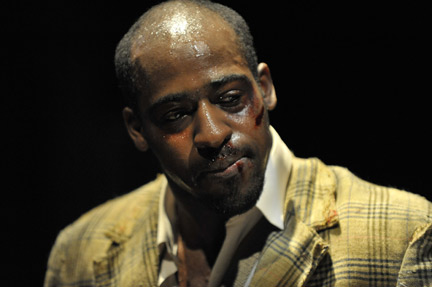
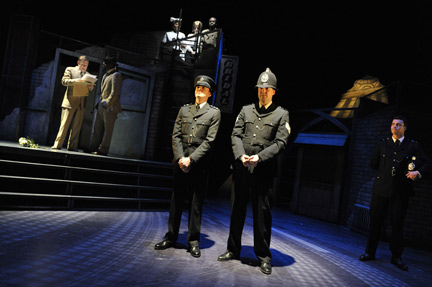
This powerful, essential production conveys the struggles and suffering of one black African immigrant stowaway to the UK (1949), who was, unfortunately, in reality, just representative of many, who were subjected to racism and cruelty. The ‘hounding’ of the play’s title was shamelessly and repetitively inflicted by two members of the Leeds Metropolitan Police Force: Kittching and Ellerker, seized upon the unfortunate circumstances of homeless David Oluwale to brutally bully and beat him relentlessly, time and time again, until the evening, of April 17,1969, when, after one particularly brutal beating, Oluwale disappeared, his battered body re-surfacing in the river Aire two weeks later. As he was a poor, obviously very ill, black vagrant, whom police and judge alike had wrongly termed ‘violent’, simply for trying to stand up for himself, the court ruled his death a drowning. Eighteen months later, a police cadet reported disturbing rumours he’d heard about the circumstances of Oluwale’s passing which had made him suspicious, inspiring an investigation into the case. During the ensuing scandal, the two officers in question, Kitching and Ellerker were merely charged with assaulting Oluwale and charges of GBH and manslaughter were dropped, while the possibility of murder was never considered, nor was racism, as the court preferred to allude that the pair’s aversion to their victim was perpetrated by their loathing of vagrancy, which was then illegal. These officers are the only ones to ever receive criminal convictions in a case involving a police-related death since records were first kept in 1970 to the present day. The investigation not only showed how many other officers were involved, in that they knew what was going on and did nothing, but also, how many colluded in the abuse. Oladipo Agboluaje’s bold, respectful adaptation of Kester Aspden’s 2007 novelNationality:Wog - The Hounding of David Oluwale is designed to serve, in the playwright’s own words, as a “suitable memorial” to David Oluwale, buried in a pauper’s grave, his name on his tombstone carelessly misspelled. ‘Wog’ was actually the nationality written for Oluwale on one of the police reports Aspden unearthed during the course of his research and it was also typed in on another form as well. The play’s many instances of violence, perpetrated upon the innocent Oluwale are all the more disturbing for their matter of fact presentation, lack of emotion on the part of the inflicting officers and repetitiveness, which may, actually, form a subtext relating to our insensitivity to violence, as long as it’s not too close to home. The play’s framework is one that aides clarity in terms of following its intense, intricate story, for this sad tale is told by David himself, not as a ghost, but as a man seeking the truth after his own untimely demise, as well as Detective Perkins, the white ‘outside’ investigator assigned by Scotland Yard to get to the bottom of David’s case. It seems easy, and right in a way, to refer to David Oluwale by his first name during the course of this review, for, having watched the marvellously alive performance of Daniel Francis as David, I feel not only as though I know more about his case, but also, something of the man himself – his hopes, his joys, his sorrows, his longings, his fears, his abuse, leading up to his downfall and cruel demise at the age of thirty-eight. Said demise was gradually perpetrated by the fierce racism of two sadistic, power-loving policemen, who were, potentially, just two of many such men in a predominantly white force at that time. Initially, a severe head injury inflicted on David with a policeman’s truncheon during an altercation in a night club had caused him to suffer from hallucinations, which, in turn, resulted in him being sectioned in 1953 and interred in a Menston mental institution for eight long years, during which time he was subjected to shock-therapy and heavy sedation. In all that time, no one visited him, once and when he was released, he became homeless. That was to be just the beginning of a series of tragic misfortunes caused by continual physical abuse by local policeman during the final years of David’s brief life. A second interment in the same institution occurred later on, and David was erroneously and casually, labelled a ‘problem’ simply for trying to stand up for himself when he was attacked, resulting in charges of ‘disorderly conduct.’ But protecting himself was an impossible task given the odds against him. In all that time, David longed for his Nigerian home in Lagos, which he had fled, against his mother’s wishes, in the hope of a better life in the U.K. Intermittent scenes, mostly during his years of sleeping rough, feature poignantly wistful moments between David and his mother, in which she advises him to think of his future and expresses her maternal feelings for him. While in Act I we are treated to some wonderfully vibrant moments during which a young, hopeful David enjoys an upbeat night out at a Mecca dancehall during which he woos a white girl who seems to be on the verge of returning his affection after which he suffers his first beating and is subsequently sectioned and interred for the first time. In reality, the real David Oluwale had a wife and two children, but this is never mentioned in this production, perhaps in order to simplify the storyline and highlight the issues more pertinent to his plight. There is not one performance in this production that is not thoroughly credible, which is something, as all of the actors, apart from the play’s two narrators, Daniel Francis, as David and Ryan Early as Perkins play multiple roles. However, in addition to its star, Daniel Francis, who plays David so believably, there are other standouts, most notably, Ryan Early as Scotland Yard investigator Perkins, the play’s co-narrator, Steve Jackson, who makes a frighteningly real Kitching, along with other credible smaller roles, and Richard Pepple in the dual roles of David’s friend Kayode, and a merchant back home, Ade. Laura Power also does a lovely turn as Janet, David’s dance-hall love interest and a low-key, but no less pivotal role as police cadet Meg, in the case of this play, the female police cadet who turns in her corrupt bosses. The sets for this play, designed by Emma Wee, are intentionally and effectively generic. As the urban action unfolds, and David’s life becomes grimmer, changing shop signs and broken windowpanes enable the feeling that life has moved on, while he’s been interred, leaving him behind. Costumes are apt, with their loose trousers and wide lapels, and the intermingling of accents, appropriate and intriguing, with northern lasses chatting to their African paramours – dialect coach Neil Swain has done his homework. Movement director Stephen Medlin has also added pivotal input, particularly in the case of Daniel Francis as David, for the actor’s increasingly decrepit body language helps to highlight the severity of his character’s many beating and his subsequent decline, inspiring compassion in those watching. Similarly, fight director Kate Waters has done a fine job of creating realism during the violent scenes of abuse. Sound design by Mic Pool suggests the river Aire and infuses the dance hall with enthusiastic vibes while the lighting design of Johanna Town alternately heightens excitement, tension, empathy and ultimately, sympathy. The premise of the play itself may be a relatively clear one, but the incidents leading up to David’s relentless torment and the officers habitual brutality of him were hidden for many years, until recently, when the ‘thirty year’ ban on releasing the information relating to David’s case (and many others) was finally lifted when the information was ‘declassified’. As it was pointed out during the course of the after show talk, that thirty year ban may have been in place for fifty years, were it not for the intervention of Harold Wilson. What’s more, this play may not have been written, were it not for the fact that the author of the book it is based on, Kester Aspden stumbled on the shocking details of David’s case in the course of researching something else and rightfully felt that it was a story that needed to be told. Similarly, Oladipo Agboluaje’s stage adaptation, as sensitively and bravely directed by Dawn Walton offers a compulsive, enlightening, crucial, must see production.
Hackney Empire 291 Mare Street London, E8 1EJ
www.hackneyempire.co.uk
EXTRA! EXTRA! www.extraextra.org
Copyright © EXTRA! EXTRA All rights reserved
|