Feature

A feature by Pauline Flannery for EXTRA! EXTRA!
The World Gold Council presents
Gold: Power and Allure
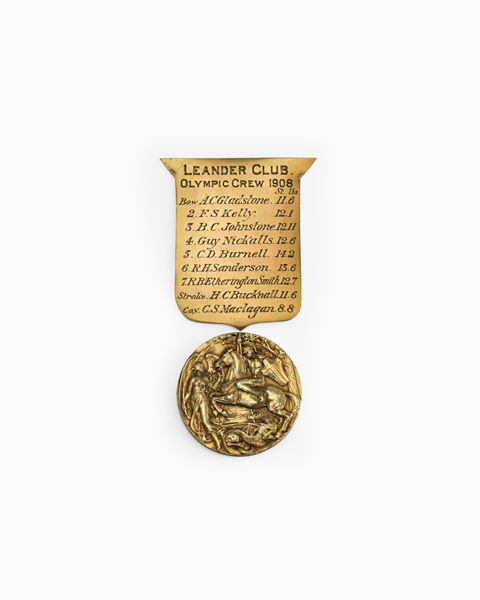
Olympic Gold Medal 1908
Curated by Dr Helen Clifford
Goldsmith’s Hall
1 June – 31 July 2012
Dick Whittington evokes Christmas - London streets paved with gold, the gold-rush - the image of waggon trails stretched across America’s mid-west. Gold belongs to a by-gone era of Arthurian rope Torcs and Loveknots. Gold is the stuff of fairy-tales like Rapunzel in her tower. Yet this week the Goldsmith’s Hall steps were covered in gold-leaf, awaiting the current Lord Mayor of London with his gold-handled scissors, to open the exhibition Gold: Power and allure. Inside, the reach of Britain’s gold heritage anticipates a golden Olympic summer.
The exhibition is extraordinary. Five years in the planning, curated by the effervescent Dr Helen Clifford, it features over 4,000 years of golden treasures from across Britain including: the Anglo-Saxon Kingston brooch with white shell and garnets, Bishop Fox’s chalice (1507) with red and green enamel, and Cardinal Reginal Pole’s pectoral crucifix, with rubies. One of the most versatile and malleable of metals from ingots to finely spun threads, gold is associated with the sun and the divine. One of the highlights is the ampulla used at Holyrood at the coronation of Charles 1, in 1633. It would fit snugly in the hand, its shape resembling a snail’s head; not for the last time did demon acquisition itch the palm.
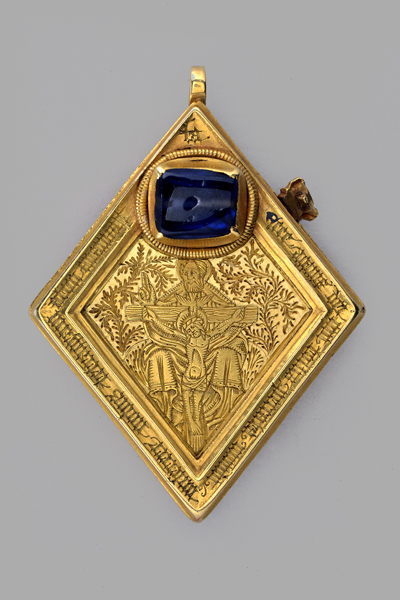
Middleham Jewel. Courtesy of the York Museums Trust
The stunning Irish Lunula, c2000-1500BC, worn around the neck by tribal chiefs, links to the contemporary piece Pleiades by Wright & Teague. Modelled by a living goddess, this exhibit is one of the most outlandish and daring in concept - a spiral of collars engraved with poetry by William Wordsworth. This is concept art at its most bold. There is an unashamed pride in the goldsmith’s craft throughout. Yet fundamentally, gold needs no justification it just is, a quality which Dr Helen Clifford understands innately.
There is gold in finance, gold in dining, gold in sport, gold in the military and gold in ‘threads and curiosities, from the first coins, crowns and guineas, including the trial of the Pyx in 1649. From the second - a pair of chocolate cups, 1700, melted down from mourning rings, with the inscription ‘let us drink to the dead,’ which show both pragmatism and gallows humour. From the fifth, the unearthly transformation of metal into thread resulting in the amazing creations of a pure gold handkerchief and ‘fur’ hat by Italian goldsmith Giovanni Corvaja. Yet additions to the swag-bag must include the toothpick and sugar nippers, 1750.
Other curios such as the early Bronze Age Basket Rings, which would keep Rapunzels’s tresses in check, and the medal depicting the Gorgon’s Head, to commemorate the execution of Charles I, stir the imagination. They are wonderful synchronicities, conversations, which link across time and across the sacred and secular divide united in craftsmanship. Gold, as a symbol of status, and means of inspiration lifts the spirits. Dick Whittington was motivated to ‘turn again.’ I would urge you to walk in the shadow of Kings and do the same.
www.thegoldsmiths.co.uk
Mon – Sat 10.00 – 17.00, Free Entry
Goldsmith’s Hall
Foster Lane
London EC2V 6BN
0207 606 7010
Copyright © EXTRA! EXTRA All rights reserved