Bite 08
Grupo XIX de Teatro presents...
HYSTERIA
Photographer Adalberto Lima
Directed by Luiz Fernando Marques
The Great Hall, St Bartholomew’s Hospital
4 June – 14 June 2008
 Couzens Couzens
A review by Amber Gregory for EXTRA! EXTRA!
When asked to review Hysteria, and told that my +1 had to be male I was intrigued as to what the evening would have to offer. Hysteria is a part of this summer’s Barbican Bite programme. Performed at The Great Hall of St Bartholomew Hospital it is certainly no ordinary theatrical setting. The audience, separated to ‘male’ and ‘female’ are herded like cattle (though I am not sure such an expression should be used in the extravagant settings of The Great Hall) up a staircase where Hogarth's "Christ at the Pool of Bethesda" mural is displayed. The building itself is one from the Baroque era, so you do quite appropriately feel as if you are going back in time when greeted by a woman dressed in Victorian clothing.
It is 1896 and The Great Hall has become a mental institution for women who have been diagnosed with Hysteria- kind of like an all girls version of One Flew over the Cuckoo’s Nest. The men had already been seated in a traditional audience viewing space by the time we, the female audience members, had been brought into the room. From the moment we entered that room we too were performers. The cast instructed us where to sit, they spoke to us, and we were also expected to respond to them. The Brazilian theatre company Grupo XIX de Teatre has produced a performance using audience participation to a level that most theatre groups would be nervous to do. Women are picked out from the audience and sometimes asked personal questions, not at all English- very Brazilian some might say. However, do not let this put you off if you are not one to who likes to show off on stage, the cast knows when it’s time to pick on someone new, or if they know you can handle being in the spotlight.
This performance has done exceptionally well in Brazil and it will be interesting to see its responses in England. The play focuses on the power that men hold over women and how a woman in 19th century Brazil would do anything for a man. The cast are all portrayed as extremely sexual beings who just want to please a man. Being an independent young British female this is extremely difficult to imagine, and throughout the performance you just want to hear a woman in the performance say something that they want, rather than simply stating that they want to be with their husband, lover or children. In Victorian England I am sure that many women felt this way, and at that time Queen Victoria lived the ideal married life that a Victorian woman should lead. However what may have strengthened the play is if we had seen some of their wants and needs aside from a traditional family life. I do think that this may not have been such an issue when the play was performed in Brazil, but as we are a country full of feminists the audience needs to feel something more than the desperate need for a man and nothing more.
Another major issue to grapple with is that of the illness ‘Hysteria’. Hysteria in women was extremely common in the Victorian era, its symptoms included faintness, nervousness, insomnia, fluid retention, heaviness in abdomen, muscle spasm, shortness of breath, irritability, loss of appetite for food or sex, and a "tendency to cause trouble" (http://en.wikipedia.org/wiki/Female_hysteria). It was an illness that would be diagnosed by a man, which could result in being placed in a mental institution, which is where this play is set. The play however is advertised saying that ‘the setting is a 19th century mental institution where women were interred for promiscuity or adultery and branded hysterical’. It is therefore possibly not seen as a place where women have been labelled by a man for little reason, it is because they have actually done something ‘wrong’ and this becomes more and more apparent throughout the play. Whether this is a directorial decision, or a cultural one (for example if hysteria in Brazil is still seen as an illness where women had committed an ‘unhealthy’ act) I do not know, but it is certainly an issue that the play raised for me. Is Hysteria supposed to be seen as a made up diagnosis or are all these women crazy because they have been repressed thus leading to Hysteria? Moving a play to the other side of the world where there is an extremely different culture is very challenging and brave. Whether or not you can personally comprehend what the women are going through in the play, all the characters are ones that you can certainly sympathise with.
Being a female audience member in this play there was a tremendous sense of belonging, and sympathy between the women and the cast. This is not something that is easy to create as theatre often likes to let you in- but at a distance. There was no distance in this production; everything is up close and personal. It was also fun. It was fun to be a woman and be involved in the performance and take part in it, it is not something one is often able to do at the theatre as a member of the audience.
As I only had the perspective of a female audience member for the performance, I asked my male companion of the evening, James Rudd, to write a short account of what it felt like to be sitting in the male audience space:
Sitting in the male part of the audience gave me a great sense of authority over the female audience members. Our sumptuous padded chairs in neat rows, superior to the women on several hard benches and wooden floor space- we had the better deal. The play began before female members of the audience were let in and then they became a part of the play- it was entertainment for an audience of men from an all female cast. As the play progressed and the harsh reality of women’s 19th century life in a mental institution became apparent, an uncomfortable guilt began to invade my conscience. Guilt that men had created hysteria to control women, guilt that my girlfriend was sitting cross-legged opposite me on a hard wooden floor - my chair began to feel uncomfortable. When the female audience members began taking part in the performance- dancing and expressing themselves freely, maybe I wasn’t so superior after all- fixed to my soft sumptuous chair.
I hope that may give a little insight to any men reading this review!
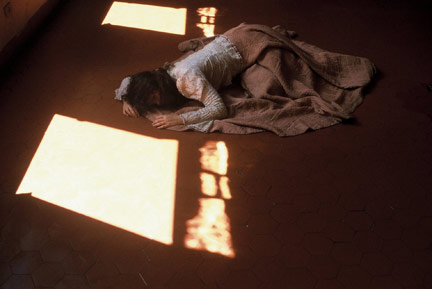
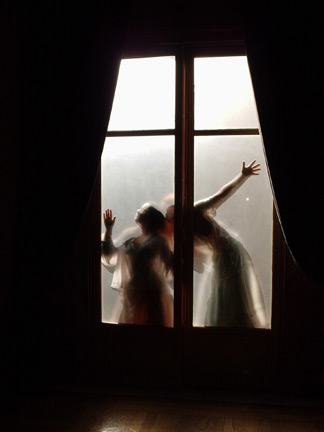
The setting of the performance worked beautifully in The Great Hall. Unfortunately some of the dialogue was drowned out by the poor acoustics but aesthetically it worked. There was no stage lighting but the room was lit in an orange tint by the natural sunlight which was simply incredible. The costumes were that of a Victorian period drama, very appropriately white or pale coloured for the setting of a mental institution.
Impressively the cast have spent the last year learning English so that this play could be performed in England. The first five minutes feel a bit of a struggle as you try so hard to interoperate what is being said through a thick Brazilian accent, but after a while you simply stop straining and it all makes sense. It is particularly spectacular that the cast are able to improvise so freely in a language which is not their own, and even create poetry! I also wish that the cast had spoken more Portuguese in the play, this is something they did rarely, and it felt as though they were nervous to do so. So much in a performance can be seen through actions and tone of voice so English was not always necessary, and the parts of the play where the dialogue slipped from English into Portuguese worked really well.
This is certainly a unique performance and is essential viewing for anybody who is a site specific/ audience participation fanatic. It is sad, touching and funny. One last question that needs to be addressed however which I don’t feel I have the right to answer, but as a spectator you may come up with your own answers... Why is it that a performance about women, performed by women, involving the audience of women, was directed by a man?
Photographer Adalberto Lima
Venue: The Great Hall at St Bartholomew’s Hospital
West Smithfield, London, EC1A 7BE
Dates and time: 4 – 6 and 9 – 14 June, 7.45pm
Saturday 7 June, 6.00pm
Also 3.00pm on Saturday 14 June
No performances Sunday 8 June and Wednesday 11 June
Signed performance: Monday 9 June, 7.45pm
Tickets: £12.00
Running time: 90 minutes/ no interval
Age guidance: 14+. Deals with adult themes
Men and women sit separately and some audience members sit on the floor.
Audience members should call the Box Office if they require a seat.
Barbican box office 0845 120 7550
9.00am – 8.00pm Monday – Saturday; 11.00am – 8.00pm Sundays and Bank Holidays
Copyright © EXTRA! EXTRA All rights reserved
|