|
Barbican Bite 09 in association with Thelma Holt Ltd. Shochiku Grand Kabuki presents
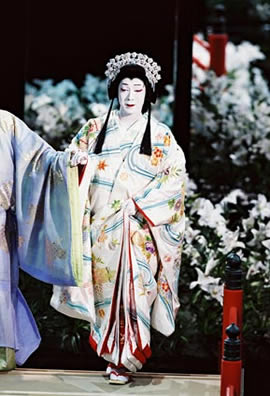
Onoe Kikugoro as Feste, Onoe Kikunosuke as Sebastian,Nakamura Tokizo as Olivia photocredit copyright by Shochiku
after William Shakespeare Directed by Yukio Ninagawa Barbican Theatre 24 March – 28 March 2009
A review by David Hermann for EXTRA! EXTRA!
How do you review a Kabuki production, when, like me, you’ve never before seen one? Where’s your frame of reference? What makes a good Kabuki good? Well, after a ridiculous afternoon of reading around in Shakespeare’s Twelfth Night while listening to traditional Japanese Flute and eating sushi from Marks and Spencer’s I finally resolved to use up the only two lifelines I had left: Phone a Friend and Ask the Audience. Aki was perplexed. I phoned her past midnight Tokyo-time and she said she didn’t know what to make of Kabuki, at all. So traditional, so highly stylised, so full of ritual and so incredibly precise - she paused - like everything in Japan, really. Japanese life itself, my friend mused, was quintessentially theatrical, so traditional Japanese theatre had to be even more so. Kabuki is Japanese times a hundred, she concluded happily. Thank you, Aki. I didn’t know it then, but her assessment explained a lot. When Yukio Ninagawa’s (traditionally) all male ensemble of incredibly eminent actors swept the stage in gaudy strides, with big, jerky movements strung together so seamlessly as to appear flowing, I could see what she meant. Everything was magnified. Then the opposite: sometimes the actors held their bodies incredibly still and transferred all movement to tiny tilts of the head, minute smirks and batting of the eyelashes. The immense pleasure in watching came from the impression that each of these movements lay within a strictly rehearsed time-frame. I got the feeling that I could have seen the show four nights in a row and each lash-batting would have happened in exactly the same spot on stage, with the exact body posture, at the exact time past the hour, down to the second. This worship of detail, as has often been remarked in reviews of Ninagawa’s work, is only possible in Japanese theatre. This sounds like a cliché, but I find it impossible to deny.
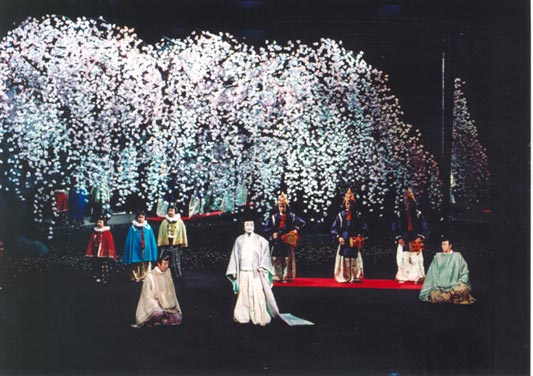
Onoe Kikunosuke as Viola photocredit copyright by Shochiku Asking the audience was less fruitful. Yes, real Kabuki, very good, authentic, is what one very forthcoming Japanese lady told me when I approached her after the show, and her husband agreed with a number of enthusiastic mid-range bows, but I got the feeling they would have said that even if the show had stunk from a mile away. On press-night about half the audience was Japanese, many wearing traditional garb, and this presence proved invaluable. There appears to be a tradition of clapping to which we are not accustomed, for example. Often, when an entrance was made, the Japanese audience broke into short, heavy bursts of applause, leaving its European counterpart to glance about self-consciously, trying to work out what had triggered the ovation. It was this complete but perfectly equanimous mystification, in fact, which seemed to unite the Europeans that night - even the grand old men of British theatre who had come to pay their respects to Ninagawa’s array of Kabuki-stars. Sir Peter Hall sat motionless, gazing intently, raising the odd eyebrow and chuckling mildly from time to time but otherwise showing no reaction at all, while Alan Rickman tried his best to join in with the special Kabuki applause scheme. I think they enjoyed it. My fellow reviewers, however, seemed more and more troubled by a lack of opinion and, in the interval, could be seen shrugging helplessly at each other and drinking heavily. And, yes, our task is difficult - no, downright impossible! I will not presume to pass judgment on the beautiful set, the breathtaking costumes, the elaborate lighting, the traditional (live) music, or the acting, which charmed and annoyed me in equal measures - all because I don’t have anything to compare it to. All I can say is that I wouldn’t miss this show for anything. So what about our very own Shakespeare, then? Surely us English lot have something to say about Ninagawa’s treatment of the bard. Well, Lyn Gardner of the Guardian felt that the production ‘resembled a very grand pantomime without the fun of the he's-behind-you jokes.’ I humbly agree but can’t help thinking that this isn’t so much Ninagawa’s or Kabuki’s fault as that of Shakespeare, whose second, more felicitous stab at the same basic premise, The Tempest, is perhaps testament to the fact that the play at hand leaves much to be desired. There just aren’t that many opportunities for those elusive ‘he’s behind you’s.’ Twelfth Night is one of Shakespeare’s oddly-proportioned affairs, where the mischievous subplot is far more elaborate and enjoyable than the thinly spread comedy of errors (the dramatic device, not the play) involving the romantic leads. As far as I could tell from the steady laughter among the Japanese audience, the Shochiku Grand Kabuki managed to carve a generous amount of comedy out of Twelfth Night - especially with the older viewers - but the non-Japanese speaking crowd appeared dizzily nonplussed.
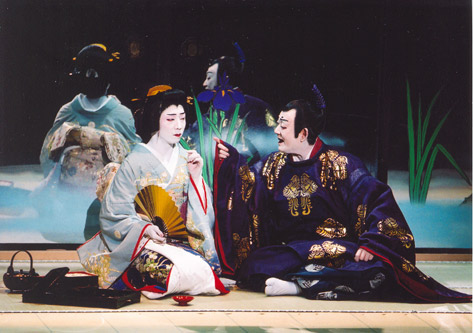
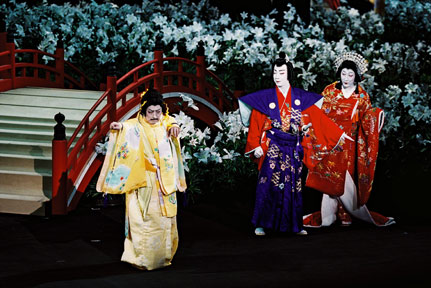
Ichikawa Sadanji as Sir Toby Belch, Ichikawa Kamejiro as Maria photocredit copyright by Shochiku The most accessible issue, however, is that of gender. Twelfth Night and the Kabuki tradition seem like a marriage made in heaven when you consider the gender-based error-comedy in the light of the all-maleness of traditional Kabuki (and on the Elizabethan stage,) in addition to the fact that costume and make-up, to the unschooled European eye, seem almost unisex. If you don’t mind being confused this is simply delicious, and for theatre-goers interested in questions of gender there is no greater pleasure than watching a man playing a woman pretending to be a man. I could go on endlessly, but to little avail. Look at the pictures, check out some Kabuki on YouTube, buy the relevant books, go to Japan - whatever you do, try your utmost to secure some Ninagawa tickets whenever the man is back in town! It is unlikely that his next production will be a Kabuki-piece (this was his first and Kabuki isn’t usually his style,) but whatever it will be, please go see it. You simply won’t get this kind of professionalism anywhere else.
Nakamura Kinnosuke as Orsino, Ichikawa Danzo as Fabian photocredit copyright by Shochiku
Barbican Theatre Tickets: £10.00 – £40.00 Running time: 210 minutes including interval Age guidance: 14+
EXTRA! EXTRA! www.extraextra.org
Copyright © EXTRA! EXTRA All rights reserved
|
 y Couzens