|
LOVE&MADNESS present La Ronde
Riverside Studios – Studio 3 5 – 21 March 2009
A review by Colette Gunn-Graffy for EXTRA! EXTRA!
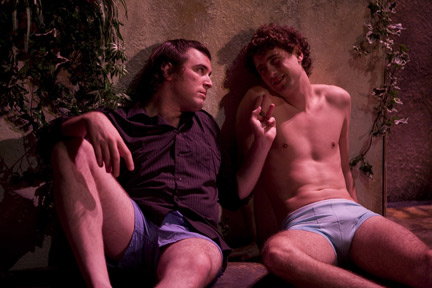
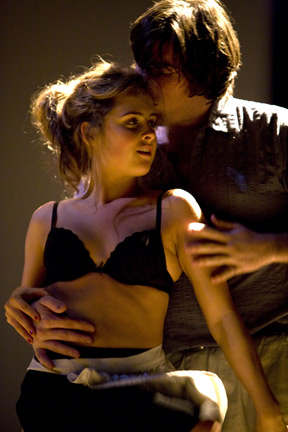
Plays and films about sex tend to provoke very strong reactions. Even in today’s liberal-minded (some might say ‘promiscuous’) society, the promise of full-frontal nudity or a passionate kiss between two members of the same sex is enough to send letters of outrage streaming into MP’s mailboxes long before the show opens. The converse, of course, is that such promises also send ticket sales skyrocketing. Sex certainly features in Arthur Schnitzler’s infamous play La Ronde, (first produced in 1903), an adapted and updated version of which is currently playing at the Riverside Studios in Hammersmith. While there is no on-stage nudity in this production by acclaimed theatre company Love & Madness, we are treated to a goodly amount of bras and briefs, quite a lot of snogging and fondling between couples of the same and opposite sexes, and one rather creepy instance of toe-sucking. Meaning ‘round dance’, La Ronde has often been described as a ‘daisy-chain’ of scenes: in scene one, we meet Character A and Character B; in scene two, Character B and Character C; in scene three, Character C and Character D, and so on. What made La Ronde so scandalous to early twentieth century society, of course, is that, in each scene, the two characters not only meet, they sleep together; in this way, Schnitzler (who had a medical background) was trying to depict the way in which syphilis was transmitted across all layers of society. In his notes on the play, artistic director of Love & Madness Neil Sheppeck says he was less interested in exploring sex as a leveller between classes as between sexualities, which is why many of the characters originally designated as male are played by actresses in his production and vice versa. Further, a female character who slept with a man in her first scene might sleep with a woman in her second, and again vice versa. So we get Frankie, a boisterous female soldier, sleeping with Leo, a male whore in one scene, and in the next, sleeping with Marie, a sweet-faced parlour maid. Although it is refreshing to see a woman play the ‘player’, watching hypocritical husband Carl take advantage of innocent (and very drunk) Sam in a hotel room is no less disturbing for the gender swap. One of the most unique aspects of the production is the way in which it depicts the sexual act itself – which in Schnitzler’s original script was indicated only by a series of dashes – as a tango between two characters. With the hot, throbbing music of The Gotan Project playing overhead, each dance has been choreographed to reflect the relationship and circumstances of the individual scene. It’s a unique and visually stunning technique. The tango between lecherous Carl and drunken Sam, in particular, is both hilarious and surprisingly beautiful.
This is not, however, to dismiss what is certainly a unique production of a rather unusual play. La Ronde has been the inspiration for both David Hare’s play Blue Room and Stanley Kubrick’s Eyes Wide Shut, neither of which emphasised to such a degree, the idealisation of sex seen in this version. Although a cynic might complain that in this production, the use of tango elevates sex to an unrealistic level of sleekness – Frankie and Leo, after all, copulate outside in the dark in what can only be a quick and messy affair – that seems to be the point. In none of the scenes do these beautiful, well-calculated dances function as the climax (so to speak). The act of sex – particularly sex divorced from love – neither heals the relationships between characters nor resolves their inner turmoil. At best, it introduces a possibility for further intimate encounter; more often, nothing changes.
Thurs 5th, Fri 6th, Wed 11th, Fri 13th, Sun 15th, Thurs 19th, Sat 21st @ 7:30pm Tickets £17 / £13 concessions / £9.50 for school groups of 15+ Box Office: 020 8237 1111 www.riversidestudios.co.uk Riverside Studios, Crisp Road, Hammersmith, London, W6 9RL
Copyright © EXTRA! EXTRA All rights reserved
|
 y Couzen