Reviewers
Bite 08
London International Mime Festival
Les Sept Planches de la ruse
Compagnie 111 and Scènes de la Terre
Conceived and directed by Aurélien Bory
Set Design by Aurélien Bory
Artistic Collaboration Pierre Rigal
Original Music by Raphaël Wisson
Barbican Theatre
January 14 – 17 2009
 ary Couzens
A review by Mary Couzens for EXTRA! EXTRA!
This beautifully performed production features a seamlessly blended mix of acrobatics, acting, dance song, and music. Its premises, most of which are suggested, spring from its function as a microcosmic reflection on humanity with its varied foibles, both on a broader scale, as cogs in the ever-turning wheel of society or, on a more personal level, as demonstrated in the case of individuals, in the guise of performers enacting their own, sometimes laughably recognisable dramas and/or melodramas.
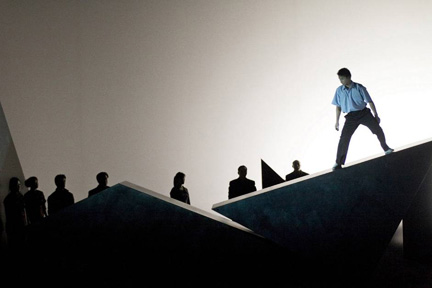
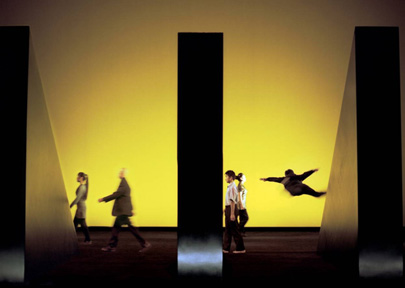
The inspiration for this unusual show was drawn from the Chinese puzzle/game Tangram, which is made up of a series of seven potentially interlocking pieces of various shapes and sizes, which are generally packaged with their geometric shapes in place as a rectangle, or square. It is then left to the imagination of the player to rearrange the pieces into recognisable or, abstract representations, without overlapping them. The dark metallic looking set, designed by the multi-talented Conceiver and Director of the show, Aurélien Bory, may mimic the pieces of that puzzling game, but despite the seemingly effortless fluidity of the continual re-arranging of its shapes by the multi-aged cast, the on stage versions of the puzzle pieces are considerably heavier, as the weightiest clocks in at 500 pounds!
From the moment it begins, Les Sept Planches casts a considerable spell over the audience, drawing collective sounds of trepidation from the more faint hearted among us whenever one of the over-sized shapes being shifted appears to come dangerously close to landing on and, potentially crushing one of the performers. But often in art, as in life, nothing is what it seems, for actions which look so spontaneous on stage, could only seem so because they have been meticulously and painstakingly rehearsed. However there is little margin for error here, as the slightest mistake could, at the very least, have the effect of imploding the show’s dreamlike fluidity like a proverbial house of cards. It’s also surprising how many things the shapes themselves suggest, either standing alone, or collectively: a cityscape, a dividing wall, plinths or towers, slides, segments of a ship, and so on. As in the game itself, what you make of things is for your own imagination to inspire.
Within the context of this multi-layered show, 21st century psychological and ancient mythological motifs and themes are also, not only inferred, but, intertwined: the siren’s call/male mid-life crises, attraction/seduction, suspicion/fear, youth/impulsiveness, longing/desire, the list goes on and on. These slowly conveyed, but nevertheless, quickly glimpsed explorations of human fragilities, revealed with the help of the oblique shapes of Tangram for their interpreters to hide behind, slide down, gracefully walk along, fall from, leap upon, or cling to, is both achingly funny and painfully touching, as much for its unpretentious, ‘candid’ moments as for the considerable, and admirable skill, dedication and focus of its acrobats, actors, dancers, composer, musician, singers and those who combine elements of all of those arts.
In one particularly striking sequence, a group of middle aged men attempt to encase a young girl between two of the towering shapes while three middle aged women in traditionally patterned Chinese satin tops simultaneously sing a plaintive song from atop individual cliff like towers, their backs to the audience. The mind automatically flits to seemingly unrelated symbols of entrapment – insects in amber, butterflies pinned to specimen boards, then notes the aging sirens which society generally deems no longer capable of masculine entrapment. This reoccurring mirroring aspect is one of the slants which makes this show so compelling, particularly in hindsight. However, this timeless, boundary-less subtext, when blended with the show’s soundless, often gravity defying, meditative movements, its perfectly synched and varying music composed by Raphaël Wisson and sounds, encompassing everything from appropriately placed chimes, bells and gongs to electronic pings and pops and the moving playing of a traditional Chinese fiddle by a member of the cast, along with its warm, gradually intensifying lighting, shifting, as the shapes are moved, from soft yellow to bold saturating red – sunrise to fiery night, arranged, with the artistic input of Pierre Rigal combines for an extremely intriguing, memorable performance.
Les Sept Planches de la ruse sometimes raises spontaneous smiles of delight, at other times, it is inexplicably poignant, but in all cases, it is always, unforgettably uplifting.
www.barbican.org.uk
19:45 pm
75 minutes – no interval
Produced by Scènes de la Terre
Co-produced by Théâtre de la Ville, Paris; Direction de la Culture, Ville de Dalian; Equinoxe, Scène nationale de Châteauroux; Scène nationale de Sénart
Copyright © EXTRA! EXTRA All rights reserved
Reviewers