
A review by Vanessa Bunn for EXTRA! EXTRA!
Triptic presents
Bernarda Alba
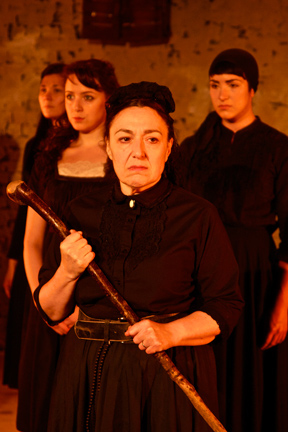
From left to right Emily Jane Morris, Amelia Adams Pearce, Beverley Klein and Soophia Foroughi
Photo by Sherry Coenen
Words and Music by Michael John LaChiusa
Based on “The House of Bernarda Alba” by Federico García Lorca
Direction by Katherine Hare
Musical Direction by Leigh Thompson
Choreography by Racky Plews
Designer - Hilary Statts
Union Theatre
23 August – 17 September 2011
Bernarda Alba is ninety minutes in duration, with no interval and this is the first hint of the intensity and oppression that permeates this production and torments its characters - it makes perfect sense to include the audience in the bound party. The setting and use of props create a rustic, earthy atmosphere and the insular and heavy mood that domineering widow, Bernarda Alba (Beverly Klein), promotes throughout is imposed on the audience from the outset when we are faced with a smoky and ominous domestic scene. Flamenco-infused music, vocals and choreography lend a distinctly Spanish flavour to proceedings and a coherent and sometimes arresting band, directed by Leigh Thompson, provides excellent accompaniment to astoundingly strong vocals from all the characters throughout the play.
Bernarda Alba is a tale about repression of all kinds and its consequences. A strong and unified cast in this energetic production ensure that this story is told effectively. A hateful widow and her array of daughters are accompanied by a senile grandmother and some all-seeing servants in this warning against subjugation in any form. The choreography by Racky Plews is both fluid and consistent. Claps, taps and clicks punctuate routines in a most rousing fashion and every inch of the theatre is utilised for creative dance and improvisation. Although there are no male characters physically present, their proximity is convincingly illustrated by the servants who sing their parts and the “heartsick” daughters of Bernarda Alba, who cling onto their every note.
Bernarda Alba is something of a parody of womanhood and motherhood with an embarrassing, provincial mindset which is at the very crux of all the tension and oppression in the play. A difficult past is implicated in the creation of this hard and uncompromising woman, but it is nonetheless, immensely difficult to sympathise with such a person, as she often comes across as an irredeemable tyrant rather than a wronged and bitter widow. The darker elements of her character are especially illuminated in exchanges with Poncia (Ellen O'Grady), her head servant, who is delightfully cynical and uninhibited and the source of most of the glimpses at humour on offer. Even more dramatic, are the often violent exchanges she has with her more wayward daughters in attempts to control them.
The costumes, though simplistic, effectively indicate the traits of their wearers - self conscious Martirio (Rebecca Trehearn) is mostly covered in cloth from head to toe and the daring Adela (Amelia Adams-Pearce) scampers about with her slight green dress, the only break in the black day dresses for mourning and the ghostly white of the nightclothes.
Soophia Foroughi as Magdalena has an incredible stage presence and delivers an impassioned and convincing performance. Emily-Jane Morris as the shy and unassuming Amelia is terrifically believable and endearing. Maria Josepha (Buster Skeggs) though tormented, senile and the most often pursued and physically repressed is perhaps the most free of all the characters in the sense that she manages imaginative escape from a doomed house that seems cursed from the opening scene and in whose fabric tears appear before the audience's very eyes.
Box Office: 0207 261 9876
http://www.uniontheatre.biz/
Union Theatre
204 Union Street, Southwark. SE1 0LX
All tickets £16
Copyright © EXTRA! EXTRA All rights reserved