|
Bill Kenwright and Laurie Mansfield in Association with Universal Music present
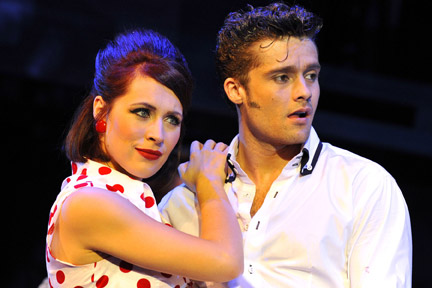
Daisy Wood-Davis (Laura) and Scott Bruton (Bobby)
ens A review by Mary Couzens for EXTRA! EXTRA!
This lively show, named after the double, million selling CD of the same name, set in the world of teenage Britain ‘somewhere in Essex’ circa 1961, seems more like a revue than an actual musical, as it features just enough of a storyline to hold its scenes together, scenes which circles around hit records of the era like ‘Bobby’s Girl,’ ‘Oh Donna,’ ‘Run-around Sue,’ ‘Tell Laura I Love Her’ and many others, meaning of course, that its chief characters are Bobby, Laura and this scenario’s bad girls, Sue and Donna. Too bad the song about Norman, who’s the Fonzie revisited character in this show was a 1950’s radio hit. The night we were in attendance, there were an unprecedented five understudies playing leading and supporting roles, due to an illness rampaging through the ranks! In America, in particular, he 1950’s was a time of intense propaganda, largely perpetrated and maintained through the then relatively young medium of television. On Stateside TV, spotlessly groomed mothers endlessly glided around palatial, equally spotless houses in big skirted dresses and pearls, perpetually dusting and presenting well balanced meals to their similarly immaculate, white bread families, whose piddling problems were always resolved with a handshake and smiles by the end of each episode. In actual fact, none of the Americans I’ve known during my childhood in the ‘60’s, or since, had ever even seen any ‘real’ people anything like these fictional, small screen characters, leading one to naturally conclude that they must have either been a figment of some wishful conservative’s thinking, or that such zombies lived in California. However, through the rose-tinted glasses of popular culture, such commercial imaginings have come to represent hyper-realities of both the 1950’s and the decades hangover period in the early ‘60’s. Taking its cue from the slightly more earthed Happy Days ethos, Fonzie aka Norman (Ben Freeman)) in this case, a much more overtly sexual fellow, bursts onto the scene at St. Mungo’s Youth Club during an audition for a lead singer for Ray’s (Stuart Ward) band. Blond, docile Bobby (A J Dean) has already auditioned, and despite intermittent cliché remarks about his ‘acne’ from bad girl Sue, his cute, babyish face is spotlessly clear. Ray’s little sister Laura (Daisy Wood-Davis) has a crush on Bobby, but he doesn’t know she’s alive. Bobby hankers after big breasted Sue (Emma Hatton) who in reality, looks and seems far too mature and world-weary to be playing a teenager. I know I was meant to suspend my disbelief, but that is a fact and one that is also shared by the actress playing Sue’s best girlfriend Donna (Wendy Paver). Ok, I also know that lots of people would say that young people ‘looked older’ back then...Though historically speaking, 1956 was considered the year that the teenagers emerged as a (consuming) force in their own right, so by ’61 teens would have more or less been ‘teens.’ Sean Cavanagh’s versatile Set Designs work theatrical magic, their rims lighting up to simulate a seaside promenade and neatly receding for urban scenes. Their collaged walls displaying advertising imagery and photos from the period always reminds us we’re watching a live scrapbook of sorts. The mandatory, red-hot rock n roll band is comprised of Ray (Stuart Ward) on guitar, Colin (Michael Kantola) lead guitar, Derek (Patrick Burbridge) alto sax, Richard (Sam Pallidio) bass, Andy (Adam Welsh) keyboard, Jeremy (Andrew Venning) trumpet and keyboard and Barry (Robin Johnson) on drums and they do a bang up job of recreating the hit parade of 1961. Despite its over-riding, predictable Americanisms, the humour in the show is both reminiscent of old school British telly and kitchen sink films of that era, which seems apt for the setting, drawing laughs and groans with its booby jokes, and the then ‘proper’ way of talking around sex in terms of ‘going all the way.’ However, the defiantly low cut dresses being worn by ‘bad girl’ Sue (and Donna at times) with no backlash, apart from predictable (and much milked) male ogling, misses its mark(s), for in reality, such baring attire would have also been met with feminine scorn during an era when people were ultra conscious of their reputations and ‘family names’ (though there is not one middle-aged or senior woman here. As my companion said, ‘your mother wouldn’t have let you go out in dressed like that.’ The pill may have well been available on the NHS then, though it probably wasn’t easily available to teenage girls, and teenage ‘tramps’ would have been judged to be so by their actions, rather than what they had on, which would have had to have been for a teenage girl in that era, misleadingly demure. In this fabricated landscape, full of hanging out, fun fairs and record hops, the fellows are simply, much more believable. Stuart Ward does a good job, both vocally and acting wise, of keeping things down to earth as Ray, the protective older brother of Laura, the atypical pert little blond in glasses who, predictably, sheds her specs and dons a frothy new hairdo, frock and heels for the big dance. A J Dean is suitably dreamy and innocent as Bobby, and (?) is rough and ready as Norman, the bad boy girls love to love. Last but not least, David Cardy does a fine turn as the older Bobby, looking back at the beginning as well as Phil, Bobby’s ‘no never-never in this house’ Dad, infusing life into his songs, and Mike Lloyd wears a number of hats effectively, playing everything from a boxer to a priest. On the feminine front, however, credibility tends to lapse, apart from in the case of Daisy Wood-Davies as Laura, who is fresh faced enough to be convincing as a teen, though, her ‘musical theatre’ delivery of her songs would have been a bit too professional to be credible, were it not for the fact that her character is studying music. Emma Hatton as Sue and Wendy Paver as Donna, however, sing a bit too much in earnest to make their delivery seem in keeping with characters who would be singing along to their radios. Conversely, Ben Freeman as Norman delivers his laughingly macho numbers (‘The Wanderer’, etc) with just the right amount of testosterone to make him recognisable as one of ‘those types’ of guys and A J Dean as Bobby manages to showcase his impressive vocal talents without ever stepping out of character, particularly excelling on his obsession, Roy Orbison’s numbers. As a result, the show is at its best during the enactments of its male oriented numbers and sometimes lags in authenticity during the actresses’ songs. This is, however, no reflection on them, but on their musical director, Michael Kantola and the show’s Musical Supervisor, Keith Strachan. That said however, Dreamboats and Petticoats offers a nostalgic trip down memory lane for those prone to humming radio hits from the pre-Beatles and Stones ‘60’s. And, judging by the cheers and applause at the end of the encores, there are a lot of people out there for whom that’s still a thrill.
Jennifer Biddal (Sue) and Ben Freeman ( Norman)
Savoy Theatre Strand London WC2R 0ET
http://www.savoy-theatre.co.uk/
http://www.kenwright.com/default.asp?contentID=1010
http://www.dreamboatsandpetticoats.com/
Copyright © EXTRA! EXTRA All rights reserved
|
-an.jpg)