|
Raymond Gubbay and the Royal Albert Hall present
Rodgers and Hammerstein’s
The King and I
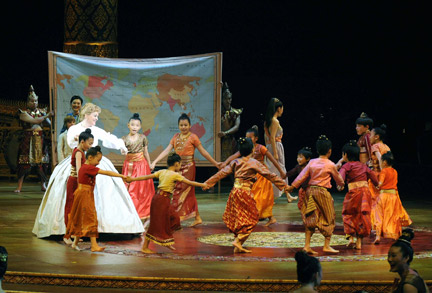
Photo by Alistair Muir
Music by Richard Rogers
Book & Lyrics by Oscar Hammerstein II
Based on the novel entitled Anna and the King of Siam
by Margaret Landon
Starring Daniel Dae Kim The King and Maria Friedman Anna
Director – Jeremy Sams
Gareth Valentine Musical Director
Robert Jones Set and Costume Designer
Susan Kikuchi Choreographer
Andrew Bridge Lighting Design
Presented by arrangement with Josef Weinberger Limited
on behalf of R & H Theatricals of New York
Royal Albert Hall
12 – 28 June 09

ens
A review by Mary Couzens for EXTRA! EXTRA!
As we made our way to our seats in the stalls of the Royal Albert Hall, the buzz of excitement may have been almost as much due to the huge, legendary venue itself as the popularity of the musical production we were about to see. The high calibre sets for this ‘in the round’ production, designed by Robert Jones, who also designed its costumes, were already visible with all their accoutrements of a 19th century Victorian wharf: barrels, chains, rope, crates, branches suggestive of a recent storm and a lone white suitcase. Enter the ship’s captain in his navy blue suite, the gold epaulets on his shoulders matching the flourishes on his hat, and of course, Miss Anna herself (Maria Friedman) in a billowing, wide skirted floor length dress and her amiable son Louie (Lewis Cornay).
Anna and her son Louie arrive on the bustling dock of Bangkok, Siam c. 1860, having travelled by boat from Singapore. The middle aged widow is in the country later to be called Thailand, to take up a teaching post. However, it is not an ordinary teaching post, for she will become teacher to some of the many children the King of Siam himself has sired with some of his many wives and Anna and Louie will be living in the his opulent palace. The palace is only meant to be a temporary home as the King has promised Anna a ‘red brick house of her own, adjoining the palace’. The King now seeks Western education for his children to offset Colonialist claims that he is a ‘barbarian.’ Miss Anna and her new maps will soon show King Mongkut of Siam the true size of his country, as compared to the rest of the world, the influences of which have been inevitably seeping in.
The musical portion of the show begins on a rousing note with ‘I Whistle a Happy Tune,’ the singing of which places musical star Maria Friedman quite happily and very competently in her element. Judging by the amount of lip-synching going on in the international audience, I think it is safe to say that that’s a number known and loved by many musical theatre-goers the world over. Friedman has always excelled at getting the message and emotions of songs across along with her enjoyment of singing them and the infectious promise offered by her cheery handling of this optimistic opener was one she capably and enthusiastically fulfilled throughout the show. Although the King, as portrayed by Daniel Dae Sim seems quite a bit younger and more model-like (as in fashion photography) than Yul Brunner - nearly everyone’s ideal, based on the 1956 film version of the musical, Dae Sim handles the role with just the right blending of obstinate machismo and reluctant tenderness to make us alternately loathe and admire him. The Technicolor film which, for most of those attending theatre today still represents their initial exposure to The King & I also starred British actress Deborah Kerr as Anna with ghost singer Marnie Nixon doing the honours on vocals, but as you can imagine, it’s a much more satisfying experience hearing the songs performed live, especially when they are sung with so much warmth and conviction by Maria Friedman. Dae Sim too handles his vocals well, imbuing them with underlyingly ironic manliness and charm, so much so that the ‘Shall We Dance’ scenes in which Anna teaches the King to waltz, always one of the highlights of The King and I, immediately set the audience to clapping and often, singing along.
But there are several other performances worth savouring in this show, among them Jee Hyun Lim’s portrayal of the King’s number one wife and mother of his heir, Lady Thiang, whose stunning vocals were an absolute pleasure to hear, particularly on her sung experiences of the King’s occasional merits, ‘Something Wonderful’ and its reprise. Similarly, the young couple from the show’s storyline who embody the star-crossed pairs being sung about in the lyrics of ‘Hello Young Lovers’, (wonderfully sung by Maria Friedman) Yanle Zhong as Tuptim and Ethan Le Phong as her secret love Lun Tha both excel on their two passionate duets ‘We Kiss in the Shadows’ and ‘I Have Dreamed,’ so much so that if you’re not too self-conscious, their passionate singing and, acting may just put a tear in your eye.
However, there is one song I haven’t mentioned here, and it is, of course, ‘Getting to Know You,’ during which Anna is introduced to the King’s children, at least those from his wives who are now ‘in favour,’ which is always a highlight of the show as the smaller children greet their new teacher with flowers and bow to her, with one of the youngest even attempting to give her a Westernised hug.
Director Jeremy Sams has wisely chosen to side-step the West End’s tendency to sugar-coat the severity akin to the ‘old ways’ in this story by allowing the audience to hear Tuptim’s agonized offstage screams when she is presumably, being tortured or killed by the King’s guards when her affair with his messenger has been revealed. This provides those watching the show with the impetus needed to accept that the King’s ways and those of his kingdom absolutely, need to change with the times. However, that said, the emotional impact of some of the more pensive moments of this production could only benefit from being lingered upon a bit longer than they are, before the pace picks up again, though it must be acknowledged that staging a production on this scale must be an incredibly formidable task!
The costumes for the show, designed by set designer Robert Jones seem to have been drawn right from the film, which was, in turn, drawn from the lavish Broadway musical. The King’s slim wives are neatly wrapped in colours inspired by blossoms with delicately ornate Buddhist headpieces, while Miss Anna’s voluminous skirts would have been all the rage for middle-class British women of her era with their stripes, white collars, bows, puffed sleeves and abbreviated matching jackets. The King shimmers in rich red and glistening gold, complete with heavy jewelled cuffs and bands on his bare ankles and arms. Mr. Jones’ sets are very impressive as well as versatile, with their initial bales, barrels and unobtrusive covering clothes being swiftly and silently air-lifted out of place to reveal the carved gold columns and peaked doorways of the King’s palace, and the shining red and gold floor which later becomes the ballroom where the King has his dance lessons with Anna. The set also features a moat surrounding the spacious performance area which casts its watery shadows on the ceiling, and wooden gangways and ramps leading up to the aisles which are made great use of as actors are able to quickly enter and exit. The huge performance space also enables the use of real fireworks and pageantry, the like of which would be impossible to stage in a normal theatre.
Susan Kikuchi’s choreography includes some beautifully staged Siamese dancing by some of the King’s many wives, complete with colourful fans and for one routine, a dragon, the body of which was comprised of several dancers. The show’s ‘Little Eva’ play within a play, based on Uncle Tom’s Cabin, composed by Tuptim for the court, also features some elaborate routines which are well rehearsed enough to seem as though their steps are actually native to their performers. In addition, the show’s ‘Shall We Dance’ waltz, as performed by Friedman and Dae Kim is performed with enough gusto and energy to bring the house down!
The sound in the Royal Albert Hall couldn’t be clearer, making it a great venue to listen to music in, and the Royal Philharmonic Concert Orchestra rises to the occasion from the overture to Anna’s moving reprise of ‘I Whistle a Happy Tune’ near the show’s conclusion, and, of course, the sparkling encore of ‘Shall We Dance.’ In truth, their sound sometimes seems more cinematic than theatrical which, however overpowering it may sometimes seem when you are there, in hindsight is actually, fitting for a production this size.
If I had one last debatable observation, albeit, one that is often momentarily forgotten in the scheme of things, it would be that as a venue, the Hall is so large that one can still feel at a distance from the performance even in the stalls. Given the loss of the customary enclosure from which to observe the proceedings, one inadvertently experiences an unavoidable loss of intimacy with the performance, however engaging it may be.
That said, there is still no denying that this stunning production of The King and I is a true theatrical event and one that musical enthusiasts will definitely delight in!
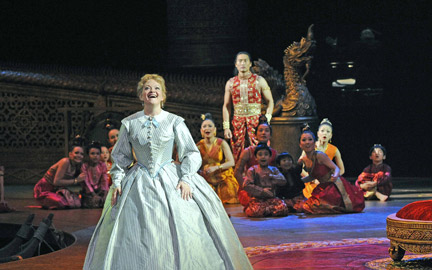
Photo by Alistair Muir
Strictly limited season – 20 performances only
Royal Albert Hall
Box Office 020 7838 3100 (9am -9pm daily)
Seats: £21.50 - £59.50
Box Seats £56.00 - £62.50
www.royalalberthall.com
Friday 19 June 7.30pm
Saturday 20 June 2.30pm & 7.30pm
Sunday 21 June 2.30pm
Tuesday 23 June 7.30pm
Wednesday 24 June 2.30pm & 7.30pm
Thursday 25 June 7.30pm
Friday 26 June 7.30pm
Saturday 27 June 2.30pm & 7.30pm
Sunday 28 June 2.30pm
An administration charge of £3.50 applies except to personal callers at the Box Office
Further information www.raymondgubbay.co.uk
Copyright © EXTRA! EXTRA All rights reserved
|