
A review by Mary Couzens for EXTRA! EXTRA!
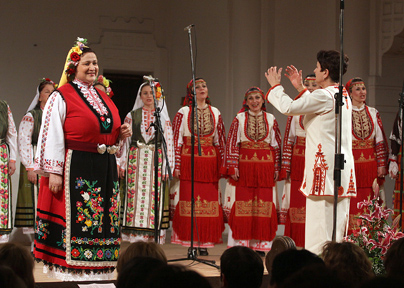
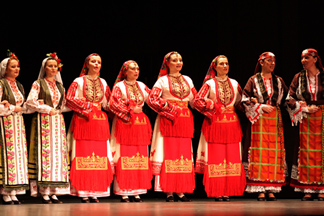
This extraordinary all female choir from Bulgaria, consisting here of twenty four members, treated their rapt audience of, judging by their instant enthusiasm, largely adoring fans, to a series of ancient Balkan folksongs, twenty one in all, in two forty five minute a cappella sets, divided by an intermission. In the first half of the concert, the women appeared in traditional Balkan peasant garb of head scarves, some decorated with flowers, long dresses of black, red, green or flaming orange with white blouses and aprons trimmed with colourful embroidery. However, in the second half of the programme, the choir reappeared in sophisticated floor length black gowns trimmed with sashes of deep purple, scarlet, wine, bronze or silver, heads uncovered, hair on show, as if to say, we are contemporary women, after all.
One of the many aspects of this choir which makes their sound so unusual to unaccustomed ears (like mine) is the fact that their voices blend ‘traditional six part a cappella repertoire with modern arrangements.’ Begun in 1952 by Geprgo Boyadjiev as the Bulgarian State Radio and Television Female Vocal Choir, now under the direction of Dora Hristova, the choir has become internationally acclaimed. Recruited from country villages for ‘the beauty and openness of their voices‘, those chosen for the choir ‘undergo extensive training in the unique, centuries-old singing style influenced by Thracian, Bulgarian, Ottoman and Byzantine history.’ Their music is most noted for its use of ‘diaphonic singing and distinctive timbre, as well as its modal scales and dissonant harmonies.’ Their first album, released in 1975 though critically lauded, did not enable the choir to achieve wider recognition, until a ‘4th generation cassette’ found its way to the ears of Ivo Watts-Russell (founder of 4AD), lent to him by Peter Murphy, singer from the group Bauhaus. Watts-Russell was hooked, a pair of anthology albums were released in 1986 and 88, under the title Le Mystere des Voix Bulgares, in 1990, the choir won a Grammy Award for their second album and the rest, as they say around the World Music globe, is history.
Arms joined, voices raised, the choir began with ‘Zazheni Se Gyuro’ (‘Gyuro is Getting Married’), music by Krassimir Kyurkchyiski. Apparently, Gyuro has been looking for a wife, and has met Yanka, whose ‘eyes look like ripe cherries, and cheeks like roses.’ It’s a sprightly number, with a triumphant little whoop at the end which sounds a bit like the ‘cuckoo’ of a clock. The women are split into groups of four, each within their group dressed alike, with six groups in all, though they all stand together in a half arch of twenty four crossing the stage, with their conductor, Dora Hristova, facing them in front.
The next song, ‘Moma Houbava’ (‘A Beautiful Young Girl’) is suggestive of clouds racing across a sunny sky on a carefree day, with beauty and definition within the layers of its leveling sounds. For the following number, ‘Galabi Goukat’ (‘Pigeons are Cooing’) (Music by Kosta Kolev) Maryia Leshkova comes forward, her plaintive tones backed by a sea of wafting harmony. As her voice bends and wavers, asking the flying birds if they have seen her family, her sorrowful tone, tinged with resignation touches the heart. Next, smiling Dafinka Damyanova takes the robust lead on ‘Tamen Oblak’ (‘A Dark Cloud is Coming’) (Music by Nikolai Kaufman) ironically warbling like a cheery song bird. Silver leaves adorn her waist and bright flowers trim her apron. The white blouses of the singers, like hers, are embroidered with delicate red blossoms.
Two men in loose white suits, the jackets of which also bear floral embroidery, sing counter-harmony on a medley simply entitled, ‘Authentic Songs’, from the Pirin area. Their resonance is astounding for its reverberating qualities. They speed up and slow the song down with ease. Another song of and about legendary beauty – ‘Moma Rousanka’ (‘A Girl Called Rousanka’), with Music by Milen Ivanov, speaks of ‘courting girls by the river, Rousanka being the loveliest of all.’ Its’ trio of singers: Binka Dobreva, Violeta Eftimova, and Daniela Stoichkova perfectly compliment one another’s voices, with a richness akin to much larger groups. As always, a lone piano note is enough to start a foursome of singers, each from a different group off on ‘Dreme Mi Se, Lega Mi Se’ (‘I Feel Sleepy, I Want to go to Bed’) offering deep, rounded harmonies, inspiring respect for the power and capabilities of the human voice. The faces of Violeta Marinova, Mariya Leshkova, Tsvetelina Velyovska, Elichka Krastanova are as expressive as their song.
And so it goes, through the gamut of emotions, as we are lured into the second half of the programme, where, among many other vocalistic jewels, we are treated to ‘Kalugerine’ (‘The Monk’) (Music by Nikolai Stoikov) about a ‘young monk who wonders where all the dancing girls were before he became a monk’. On the striking ‘Danyova Mama’ (‘Danyo’s Mother’) with music by Nikolai Kaufmann, soloist Binka Dobreva trills expressively, as though begging our sympathy and understanding. If it seems as if she’s singing of something ageless and inevitable, it’s because she is: “When you were a baby my boy your father left home to fight for freedom. Now you are leaving me too for the same reason. Please my child, don’t do it, come back home, let me live to see you married, let me look after my grandchildren.” It was ever thus. Ms.Dobreva’s singing and that of the choir is truly, sublime.
Applause throughout has been rapturous, and during the choir’s lively little encore, full of upbeat tones, whoops, offbeat warbles and little bark like sounds, they toy with their audience, seemingly offering us something we all know they could never be capable of in the least – disharmony.
http://www.serious.org.uk/mystere
http://soundcloud.com/barbican-music/le-mystere-des-voix-bulgares-3
Listen:
Kaval Sviri (from Le Mystere Des Voix Bulgares Vol.II, released on 4AD in 1988):
http://soundcloud.com/barbican-music/le-mystere-des-voix-bulgares-3
Be sure to listen to Lucy Duran’s upcoming session/ interview with Le Mystere Des Voix Bulgares for World Routes/ BBC Radio 3 on October 9th
http://www.bbc.co.uk/programmes/b006tnmp
Le Mystere Des Voix Bulgares
On Tour Autumn 2011
October
Wed 19 BELFAST Ulster Hall
As part of the Belfast Festival
02890 971197 http://www.belfastfestival.com
Thu 20 EDINBURGH Usher Hall
0131 228 1155 http://www.usherhall.co.uk
Fri 21 MANCHESTER Bridgewater Hall
0161 907 9000 http://www.bridgewater-hall.co.uk
Sat 22 GATESHEAD The Sage Gateshead
0191 443 4661 http://www.thesagegateshead.org
Mon 24 CAMBRIDGE Corn Exchange
01223 357851 http://www.cornex.co.uk
Tue 25 BRISTOL Colston Hall
0117 922 3686 http://www.colstonhall.org
Fri 28 LEEDS Town Hall
0113 224 3801 http://www.leedsconcertseason.com
Sun 30 BIRMINGHAM Town Hall
0121 780 3333 http://www.thsh.co.uk
November
Tue 1 BRIGHTON Dome
01273 709709 http://www.brightondome.org
Wed 2 BASINGSTOKE Anvil
01256 844244 http://www.anvilarts.org.uk
Copyright © EXTRA! EXTRA All rights reserved