|
Love & Madness Ensemble
Macbeth
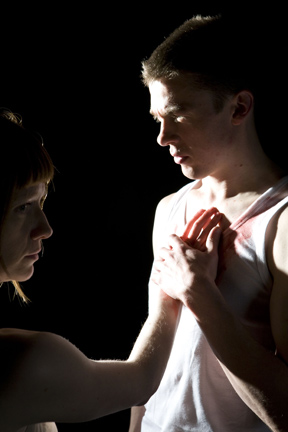
Jody Watson and Will Beer in Macbeth Photo by Luke Varley
by William Shakespeare
Directed by Neil Sheppeck
Riverside Studios
20-May – 22 July 2009
A review by Samuel John for EXTRA! EXTRA!
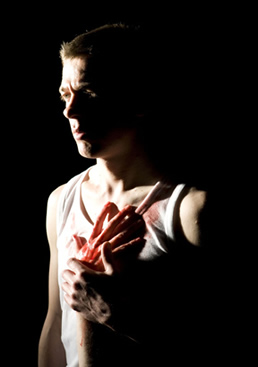
Macbeth conjures up images of blood splattered warriors in heavy armour and vast stone castles, witchcraft and bitter heath-covered highland landscapes. The Love and Madness ensemble deviate from this archetype and as they transport us to a pub on the day of the 1966 World cup final, a great day for English patriotism and possibly the greatest moment in their sporting history, we are informed we are not about to witness The Scottish Play in its traditional setting. The promenade aspect of the performance is introduced by free wine being offered at the bar upon entry, and a third or so of the audience being seated at tables in the onstage pub. It became immediately apparent that for some, the evening would serve to be more than a purely passive experience. It is as old a challenge as Shakespeare’s words themselves, to stage the Bard in an alternate historical and social context. In this instance, the Scottish monarchy is replaced by an East End Gangland hierarchy in the 60s, a period made infamous by the Kray brothers and their dubious moral code. The fear of crossing the Dons is a fitting comparison to the ultimate blasphemy and treachery of ancient times, the murder of the King. The authentic '60s costume and accurate cockney accents effectively suspended the disbelief of the period; however, such allegiance to the accents meant that it was at times in conflict with the rhythm of the pentameter. A couple of the actors spoke with thick Northern Irish accents which seemed to have greater symbiosis with the text. Whether the decision not to have them in continuity with the accents of the majority was a creative one or a practical restriction of the rep cast was unclear. Although the departure from Medieval Scotland was at times a distraction, it was often a pleasurable one which many relished. The Witches were cleverly embodied by 60s’ societal scapegoats, gypsies. The minstrel couple, Kate Robson-Stuart and Arran Glass, sang the haunting verse to well-written folk melodies in pleasurable close harmony, accompanied by their fiddle and guitar. They served more as insightful narrators, allowing the audience to be alienated from the action, as opposed to being the puppeteers of Macbeth’s conscience. “So foul and fair a day I have not seen” was a reaction to the telly fizzling out at a climactic moment in the football, much to the frustration of Macbeth and Banquo. This gets a laugh from some members of the audience, as does gesturing to the male Witch/Gypsy with “You should be women, and yet your beards forbid me to interpret that you are so”. An audience of school students who may be watching a live performance of Shakespeare for the first time, in preparation for their GCSE set text, may have been left feeling as though they had missed something, and ever further from engaging in an in-depth understanding. Veterans of the text, however, are able to revel in the fresh and witty interpretations. Unfortunately for the former, the director’s (Neil Sheppeck) interest seemed to lie more with those with years of Classical familiarity, despite the gangland code pandering more readily to modern comparisons. Pivotal to the epic is a fresh-faced Will Beer in the title role. His turn as an impressionable Jack the Lad was an un-orthodox choice for the usually world-weary and haggard medieval warrior. As the play continues, however, he develops and becomes ever more convincing as a young man in conflict, ruled by insecurity. His brittle character makes a very gentle Lady Macbeth (Jody Watson) compatible, and their electrifying sexual chemistry enables her to tenuously maintain manipulative control. Mr. Sheppeck chose to forego the Porter character, instead, having his contribution ingeniously delivered by Lady Macduff (Lucia McAnespie). She was a true joy as she drunkenly postponed attending to the knocking. Her mastery of animated facial timing ignited what is often a problematic and antiquated monologue, into the comic way station Shakespeare would have intended. There are questionable decisions, such as the excessive use of video projection, which is only put to good use once to portray the ambush of Macduff’s family. The scene involving Banquo’s Ghost was also a little unfocused. With no physical Ghost present, the on-stage audience seemed to dilute Macbeth’s horror and the onlookers’ confusion. The true commanding performances belonged to Matthew Sim as Duncan and Dan Mullane as Macduff. Mr. Sim is every bit the Godfather, whose Napoleonic stature greasily commands ultimate respect. Mr. Mullane is the only cast member who smacks of the brutal alpha-male empowerment one expects of a killer who will stop at nothing in the pursuit of justice. His reaction to the fate of his family is gut-wrenchingly moving. The culminating nail-biting finale, skilfully choreographed by Gordon Kemp, literally had the audience on the edge of their seats, not least because they were located within the knife-wielding combat-zone itself.
Will Beer in Macbeth Photo by Luke Varley
Box Office: 020 8237 1111 £17 (£13 concs) Riverside Studios Crisp Road
Copyright © EXTRA! EXTRA All rights reserved
|