|
North East Area NUM, the RMT, UNITE and the GMB present
Maggie’s End
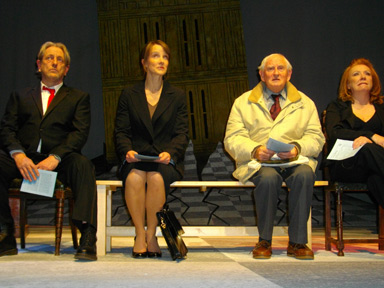
Photograph: Tristram Kenton
by Ed Waugh and Trevor Wood
Directed by Jack Milner Shaw Theatre 7 – 18 April 2009
A review by Mags Gaisford for EXTRA! EXTRA!
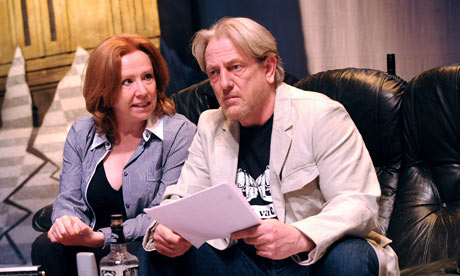
Will Maggie Thatcher ever end? This play was inspired by press reports of the Government’s proposed plans to hold a state funeral for the Baroness in the event of her death. After its successful run in Durham it’s being brought to London by the National Union of Mineworkers to mark the 25th anniversary of the Miner’s Strike. Writers Ed Waugh and Trevor Wood explore the possible repercussions of such an event, where a widespread feeling of outrage at this ultimate betrayal would re – open the wounds inflicted on many communities during the Thatcher years. In their newspaper – style programme, they state their intentions: ‘Despite Mrs Thatcher’s death being the catalyst for the play, Maggie’s End is really about the legacy of Thatcherism and examines how far the New Labour government has travelled from its traditional roots.’ The drama revolves around a conflict between Leon Thomas (Mark Wingett) and his daughter Rosa (Johanne Murdock), whose filial relationship is obliterated by political opposition. Leon is not the man he used to be. This one – time militant campaigner, ‘messiah to the anti – poll tax demonstrators’, previously imprisoned for his efforts, is now a self – confessed ‘bitter, washed up idealist’. Muted by the powers that be, crippled by nostalgia for a time when revolution seemed possible, he occasionally swaps his sofa for the university lectern. He uses this platform to berate his politics students for their apathy. Faint echoes of his campaigning zeal are now drenched in satire, as he seems convinced his words are falling on deaf ears. At the start of the play he sets an essay: ‘New Labour is the bastard child of Thatcherism. Discuss. And try to reference someone more relevant than Paris fuckin’ Hilton.’ What hope, then, for his daughter? It becomes possible to see why Rosa has chosen an alternative path for herself. Motivated by ‘pragmatism’ and ‘realism’, Rosa claims to be seeking change from the inside. She’s rising fast through the ranks of the New Labour Government, via a seedy office affair with Neil Callahan, the pantomime - villain home secretary and lap dog of the Thatcherite Prime Minister. So the funeral plans, coinciding with the death of Leon’s mother, bring events to a head. Rosa swings between a fast – fading sense of loyalty to her pathetic father - figure and the temptations of power and prestige whose clutches are becoming impossible to resist. What must Rosa sacrifice for this power and prestige? And, more importantly, just what does she intend to do with it? There’s an amusingly poignant moment where the sleazy Callahan, when asked by Rosa just what the values of the New Labour Government are, answers ‘good – old fashioned loyalty’ - before pulling up his trousers and running off to his wife’s champagne birthday celebrations. It’s certainly a thought – provoker. Are socialist ideals still possible in today’s society? Have the dividing – and – conquering mechanisms of power unravelled all hope of solidarity built up by the Trade Unions? Is the only choice between futile, doomed attempts to protest and ruthless individualism? The story is engaging and highly relevant. Peppered with witty one – liners about the malaise of ‘Big Brother’ society, the play begins to challenge the boundaries of drama in the political domain. But I couldn’t help feeling a mild sense of confused identity about this production. The set is simple - sterile, even – and the stage directions minimal. The agenda is clear and un– contested, to the point where the characters lack depth and there are gaps in the story. Would this have worked better as a televised production? The specific strengths of theatre could perhaps have been exploited further. With such a clear political agenda, could the writers have taken advantage of the live audience, pushing those dramatic boundaries further? People were certainly willing: in Leon Thomas’s lecture scenes the audience were desperate to answer back. Or, was the resulting sense of frustrated communication a criticism of Leon’s defeatism, in his refusal to properly engage with his audience? The programme includes opinions from politicians, including a rather hopeless defence of Thatcher by the Daily Telegraph’s Andrew Pierce, arguing that ‘the strong feelings she generates is a mark of the Lady’s greatness’. This is an unconvincing attempt, I feel, on the writers’ behalf, at partiality: the quote is surrounded by the logos of the Trade Unions that support the play and there’s no question of whose side they’re on. It’s a strong and unified cast. Johanne Murdock tackles Rosa’s complex identity with finesse and Melanie Hill plays a wonderfully wistful and supportive (if faulted) wife to Wingett’s Leon Thomas. Robert Fyfe provides some welcome (if a little predictable) comedic relief as the senile ‘Uncle Arthur’. The Guns of Brixton scene-change tune is replaced at the end by the Manic Street Preachers’ If You Tolerate This Then Your Children Will Be Next: one of the less subtle elements of the production. But there is no doubt this play will strike a chord with many. It was received with heartfelt standing ovations. Indubitable echoes of Blair’s Iraq speeches in Neil Callahan’s creepy televised public addresses highlight the urgency of its message. If today’s political climate is indeed so disastrous, is the issue of a state funeral even relevant? There is something hopelessly futile about debating the events surrounding the natural demise of an old woman whose damage is long since done and will continue to thrive without her. Or is there? Discuss.
Box office: 08715943123 www.theshawtheatre.com 100 – 110 Euston Road, London NW1 2AJ
Copyright © EXTRA! EXTRA All rights reserved
|
 Couzens