Opera Review

A review by Barry Grantham w for EXTRA! EXTRA!
THE BEGGAR'S' OPERA
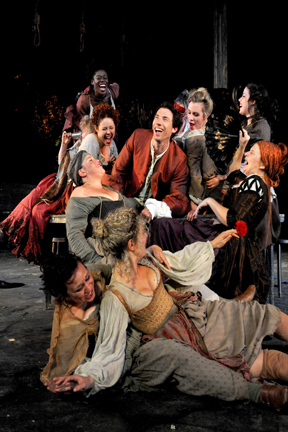
David Caves and Company in The Beggar's Opera at Regent's Park Open Air Theatre.
Photo Alastair Muir
Ballad Opera by John Gay
Director: Lucy Bailey
Movement Director: Maxine Doyle
Designer: William Dudley
Arranger and Musical Director: Roddy Skeaping
Open Air Theatre Regents Park
23 June – 23 July 2011
The Beggar's Opera, to be seen at Open Air Theatre Regent's Park, is a very worthy work. By that I mean that the creative staff and the cast have approached the vehicle with all due respect and diligence, and with skill, affection, understanding, and persistence. At last night's press showing (and I'm sure only last night), it proved an offering in two parts; the first act lacking flair and conviction. But by the second half, they had found their footing and the audience began to respond, culminating in a deserved ovation by curtain time
The history of The Beggar's Opera is a most interesting one. In early 18th century London, Italian Opera became all the rage. Italian singers like Faustina and Cuzzoni were the darlings of the upper crust. English music had been doing quite nicely, thank you, with Purcell and Arne, but now the public would have none of it, (even Shakespeare was quite banished from the stage). Still, there were those who found the whole thing ridiculous, among them Mr John Gay, poet and friend of Jonathan Swift, who had suggested that 'a Newgate Pastoral, among the whores and thieves of the prison', might be a corrective to the ridiculous stories of gods and heroes of Italian Opera and its posturing performers.. If London's elite would have nothing but Italian, why not create a opera for the lowest strata of the city's populace - the beggars with a story they would appreciate. So that is how it got its name – it is an opera for beggars, not about beggars
The story concerns Macheath. a renowned Highway man, his betrayal by thief catchers Mr and Mrs Peacham, and their daughter Polly's love for the highway man. The witty and satirical lyrics are set to popular tunes already familiar with the audience. The production was first presented in 1728 by Gay and John Rich, owner of the Lincoln's Inn Fields Theatre. And was an immediate and profitable success – inspiring the oft quoted – 'It made Rich gay and Gay rich'.
But it was certainly not to Victorian tastes, and it was forgotten until revived by Sir Barry Jackson at the Lyric, Hammersmith in 1920 and again in 1925 with costumes designed by Lovat Frazer. Macheath was played by Frederic Ranelow, from whom – (and here is a personal recollection), I received voice coaching in the 1960's. Included in his method was the use of a small plastic devise, about ¾ in. high (and charged for at 2 guineas), which was placed between the teeth as one attempted to annunciate a series of consonants.
It was a few years after that Lyric production that Berthold Brecht and Kurt Weill made the brilliant adaptation under the title of The Three Penny Opera.
The present production of The Beggar's Opera has a large cast, who are without exception excellent .Mostly actors, rather than singers, their success is due more to characterisation than to vocal ability, which vary from adequate to tuneful. It is very much a team effort with no stars, and this greatly benefits the production. I will not pick out individual performers but, when you go – and please do if you can, you will doubtless find your favourites.
The production team, however I will identify. Firstly, director Lucy Bailey, whose work is a triumph of inspiration, attention to detail and a gift for comic business. In the second half the audience, including myself, began to laugh when Peacham and Driver's vows of eternal friendship end by mutual strangulation. Scenes between the rivals for Macmeath's affection are also a
comic delight. Likewise, Miss Baileys handling of 'the Parade to Tyburn' and the startling finale are a lesson in crowd deployment. In this scene, as everywhere, she is helped by the innovative and flexible set devised by William Dudley. And lastly, the work of choreographer Maxine Doyle, styled 'movement director'; a title with which I would generally concur, though certain scenes also merit the term 'choreographer', as in a delightful dance sequence.in the second act, which includes a cameo around a bench beautifully danced by both boy and girl .
Finally, there is a glimpse, very much in the background, of a Harlequin and Columbine - a reference appreciated by those who are aware that John Rich under the name of Lun had gained great success in the mask of Harlequin.
Open Air Theatre
Inner Circle, Regent's Park NW1 4NR
Evenings at 7.45pm .
Matinees 2;15 (July 2, 7, 9, 14, 16, 21,23.)
Box Office: 0844 826 4242 boxoffice@openairtheatre.org:
£19 - £46
Copyright © EXTRA! EXTRA All rights reserved