|
Hen & Chickens Theatre presents
On the Permanence of Fugitive Colours
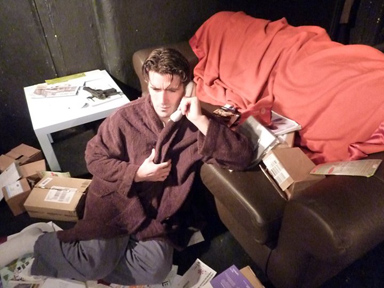
Bruce Lawrence in Do Not Call
Do Not Call &
Writer: Cyd Casados
Director: Samantha German Hen & Chickens Theatre
2 – 20 March 2010
A review by James Buxton for EXTRA! EXTRA! Do Not Call, the first of the evenings three short plays, features a man about to commit suicide interrupted by a cold call from a woman selling life insurance. This is a black comedy that explores the pressures of modern life. Susan, the telesales operator, played by Tova Leigh captured the constantly cheerful, bubbly manner of a telesales operator well. Sitting at a desk on stage left, she talks into her headset encouraging Joe to believe life is worth living. By getting Joe to engage and talk about himself in order to interest him in the insurance, she unwittingly becomes his counsellor. When she lets on she has already taken four calls that year about people committing suicide it becomes apparent that coming across attempted suicide in her line of work is not uncommon and through her prior experience she realizes that his is a cry for help; the irony of the help coming from a telesales operator is poignant and amusing. Bruce Lawrence as Joe, the would-be suicide was perhaps a little too well groomed and unflustered for a man contemplating taking his own life but perhaps his lack of desperation was symptomatic of a man who didn't actually want to kill himself but just wanted someone to talk to. The sound of answering machines and phones going off at the start and end of the play added a chaotic atmosphere which suitably reflected the pressure on Joe, as he sits surrounded by the mail he has opened that he was supposed to deliver. The Interview, the second play of the evening, is a scathing satire on the corporate world. Elizabeth, played by Tova Leigh is an eager candidate being interviewed for the ultimate sell your soul job - apprentice to the devil, played by Laura Pradelska. Tova Leigh acted well, as an ambitious, power hungry woman who would stop at nothing to get the job, while Pradelska played the ruthless, sexy devil with haughty ease. There were some nice touches where Pradelska refers back to Elizabeth's CV to remind herself of her name and there was definite chemistry and good energy. The use of corporate language was enjoyably ridiculed and the play effectively satirized the highly competitive, egocentric attitude of corporate management. Using the same set up as the previous play of a desk and a couch, images of Bush and other politicians were hung on the wall, referencing how these men were making it a good time to be the devil. However, the play lost a great deal of energy as it moved from satirizing a job interview to a fantasy relationship between the devil and God (Bruce Lawrence) and could have done without making the reference that Pradelska was the devil so explicit. On the Permanence of Fugitive Colours, the headlining play of the night features Natasha Staples as Rebecca, a sexually driven woman and her relationship with her artist lover, Steve, played by Bruce Lawrence. The play asks some interesting questions about monogamy and whether it is natural for humans to limit themselves to one partner. The natural dialogue explored the issues in a relaxed, sexually charged way and there was believable chemistry that worked well on stage. Staples played a woman who defined herself through her power to arouse men with provocative sexual power as she strutted around the stage. Staples exemplified Rebecca's skittish behaviour, suddenly whirling out of Steve's arms in fits of passion as he questions her insecurities, identifying herself with butterflies that never have one partner, she fervently resists a monogamous relationship for fear of losing control through her sexual appeal. Bruce Lawrence as the artist portrays a man genuinely sympathetic to her insecurity, but by trying to pin her down, he makes her become more resistant and unpredictable. The set of the artist's studio with a few easels and paints gave the impression of a relaxed, free environment that both lovers felt comfortable in as they discussed their polygamy. At times the play boarded on cliché, however, as painting became a kind of sexual release, which detracted from the genuinely interesting questions of why polygamy is still, only accepted for men. This final play left me with the feeling that Rebecca isn't an independent woman with a high sex drive as she believes, but, in reality a woman who depends upon being attractive to men and her arguments for polygamy were just a cover to justify her own insecurities about fear of commitment. From telesales to an interview with the devil to a polygamous romance, Cyd Casados has taken an interesting array of subjects that together, make for an entertaining evening. Her plays work best in the realm of satire and she has a natural talent for believable dialogue. However, her self- empowered female characters run the risk of being a little caricatured. From Susan, the girlish telesales woman to Elizabeth, the extremely ambitious woman in the job interview and Rebecca, the sex maniac, Casados undermines the notion of feminine self-empowerment by making the characters too defined by their girlishness and/or their lust for power and sex. As a result they become less real and more like stereotypes used to satirize a particular issue rather than fully realized characters which raise them.
Box Office: 020 77042001 Theatre Website: http://unrestrictedview.co.uk/page/venue.php?id=1 Hen & Chickens Theatre
Copyright © EXTRA! EXTRA All rights reserved
|