|
Reviewers
New End Theatre presents
Bette Bourne as Quentin Crisp in
Resident Alien
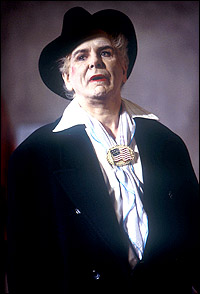
Written and Directed by Tim Fountain
New End Theatre
28 January – 5 April 2009
 ary Couzens ary Couzens
A review by Mary Couzens for EXTRA! EXTRA!
Quentin Crisp, writer, actor, raconteur, gay icon/activist, (despite remarks which might have seemed to the contrary), individualistic Englishman in New York – this show manages to encompass all of those aspects of the late artist’s model (of thirty years standing) turned celebrity and commentator, thanks to the multi-dimensional writing of Tim Fountain and the marvellously alive performance by Bette Bourne. Crisp’s unforeseen rise to notoriety began on the street level with his defiantly flamboyant clothing and persona raising eyebrows as well as attention in London’s Soho in the 1930’s when homosexuality was still illegal, before a few choice words on radio in the 1960’s encouraged the completion of his autobiography, The Naked Civil Servant (1968), the television dramatisation of which eight years later in 1975 made overnight stars of both himself and John Hurt who played him. Resident Alien places Crisp in his tiny New York apartment during the course of one day in the final year of his life, at the age of 90 and demonstrates his failing health, increasing frailty, philosophical outlook and never ending penchant for living.
Bette Bourne’s enthusiasm and timing in this one man show is uncanny, so much so that the lines are immediately blurred between his acting and mannerisms and the wit, wisdom and persona of Quentin Crisp himself. This seemingly spontaneous performance is infectious to the point that the audience, further confirmed by several overheard interval comments, almost feels as though they are privy to a private visit with the man himself – a great compliment to both the writing and directing of Tim Fountain and the stellar performance of Bette Bourne as Quentin Crisp.
Crisp preferred to give his forthright opinions on everything; damn the torpedoes as WWII generation Americans were wont to say. This trait sometimes inspired wrath, not only from the gay community, particularly for his off the cuff, admittedly insensitive reference to Aids as ‘a fad,’ which he later explained as his attempt to disengage homosexuals from disease in the public consciousness, and also for his unpopular comment that Lady Diana Spencer ‘got what she deserved’ and should have ‘known better’ as Royals never ‘marry for love. ‘ However such controversial remarks were an integral part of the Crisp character, which for him always meant saying exactly what he meant. A friend of his was known to comment that, if Quentin was being rude, at least ‘he’d be polite about it.’ Which may be one of many reasons why this diverse, fascinating monologue also includes entertaining, yet sensible conclusions about Crisp’s philosophy, based on experience, that charm and style are more important than money.
Crisp’s imaginatively candidly droll way of putting things, not only lead to laughter, but also on occasion, great insight. However, the play opens with Bourne as Crisp watching someone whose show he confesses, he is addicted to, namely, Oprah Winfrey, whom he admired greatly as she’d ‘come from nothing.’ During the course of our visit with Crisp in this one man play, in addition to topics mentioned, he expounds on: celebrity culture, keeping his telephone number in the New York directory (he insisted on speaking to anyone who called), Oscar Wilde, Andy Warhol, honesty, marriage, Joan Crawford, politics (which he didn’t take seriously), Margaret Thatcher a.k.a. ‘Mrs. Snatcher’, education, house-work, make-up, movies, death, the differences between Englishmen and Americans and their social systems, music, heterosexuals vs. gays (‘We have everything in common, apart from the funny way we spend our evenings’), uniformity, manners, the historic origins of camp, his early days in Soho, his love life, freedom and contemporary man and, the importance of interior journeys over exterior ones, a point which was intermittently stressed.
Paul’s Shaw’s set heightens the sense of an intimate visit, with its hot-plate, dirty dishes, piles of laundry, shelves of unopened books (‘Books are for writing, not reading.’) and greasy looking walls. Crisp lived in a bed sit in the centre of London for forty-one years before emigrating to New York in 1981 at the age of seventy-two, where he lived in, ‘the last rooming house in New York’, in a single room with a shared bath. He didn’t believe in house-cleaning and famously commented that ‘the dirt doesn’t get any worse after four years.’ Having been in some fairly peculiar apartments in New York, I have to say that Shaw has captured the down at heel ambiance of the city, through his set, and his version of Crisp’s home landscape seems an accurate one. Lighting designer David W Kidd opened the play before it actually started on a rather poignant note, given Crisp’s enduring love of Manhattan, with the bare light-bulb of a table lamp illuminating the lone picture on the wall of his apartment, a frameless black and white night shot of the New York skyline, with the Brooklyn Bridge in the foreground.
Although I may not always have agreed with all that was being said by his character, thanks to Bourne’s enlightening performance as Quentin Crisp, I was able to appreciate the man himself, particularly for his great honesty and courage. It takes a lot of guts to be oneself, whatever the weather, and Crisp was always a fiercely independent individual. Dressing as effeminately as he did, particularly in homophobic London of the 30’s – 60’s couldn’t have been easy, and being outspoken along with it, must have seemed downright dangerous at times, but Crisp always stood his ground.
Speaking of which, standing ovations are all too rare in fringe theatres, though they are sometimes, deserved. Not only was the rousing ovation at the end of Resident Alien, which my companion and I participated in, well-deserved, but given the source of Bourne’s inspiration, it was also one that was uniquely spirited.
New End Theatre
27 New End
Hampstead, London
NW3 1JD
0870 033 2733
www.newendtheatre.co.uk
EXTRA! EXTRA! www.extraextra.org
Copyright © EXTRA! EXTRA All rights reserved
Home
Reviewers
|