|
The Frontline
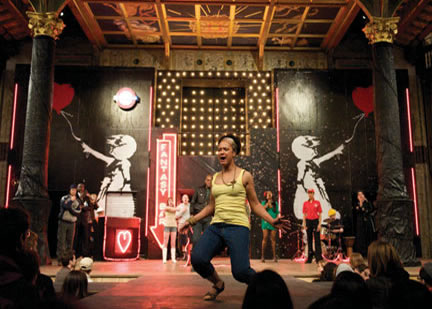
Golda Roshuvel as Beth in Che Walker's The Frontline at Shakespeare's Globe Photo by Manuel Harlan
by Che Walker Director - Matthew Dunster Composer/Musical Director – Olly Fox Designer – Paul Wills Choreographer – Georgina Lamb Shakespeare’s Globe 5 – 23 May 2009
A review by Mary Couzens for EXTRA! EXTRA! RA! EXTRA! www.extraextra.org When this play, meant to depict 24 hours in the life of the human milieu hanging around London’s teeming Camden Town tube station was presented at the Globe last year, it was the first play set in contemporary times ever to be staged there. Now in revival, this bustling ensemble piece returns to the Globe’s seminal outdoor space, filling the chilled, largely twenty to thirty something Friday night crowd’s ears and the chilly air with a mixed bag of music, drama and humour as well as a fanfare of expletives of the distinctively non-Shakespearean kind.
Stereotypes abound in this play, but many of them are not of the ilk that seems indicative of Camden Town, particularly for those who’ve been there, done that and ripped and/or whipped their t-shirts off and on over the past few decades. Among the more blatantly invisible in terms of characters are Camden’s plethora of aging hippies, punks (both former real McCoy’s and younger, spiked tourist photographed) rockers, Goths and psycho-billy practitioners who still manage to make their presence felt on the streets and in Camden’s many charity shops and increasingly commercialised markets even if often mainly via the continuing popularity of their throwback related paraphernalia. Despite the fact that these people still form a formidable portion of Camden’s resident population, along with grass roots activists of various ages, not even a whisper of either more obvious faction echoes through the action of this play. Instead playwright Walker focuses on the struggles of Camden’s black and immigrant population, i.e. Somalian and Ethiopian with assorted largely ineffectual white males filling in as foils, in a neat bit of ‘white world’ role reversal, which I actually, commend, (though would prefer demonstrated with a tad more originality) along with various inevitably weak white female characters, who cling to their sons and lovers, whatever their physical or moral persuasions in similarly mindless fashion. The only white immigrant, a Polish girl in hot pants is a prostitute. Thankfully, the play’s black characters offer a much more realistic cross section of mankind with all its longings, hits (re: drug use), hiccups, battles, lusts, and, of course, fears, sometimes leading to forms of madness along the way for natives and immigrants alike. However, the production’s lethal combination of a cast of twenty - two (whose photos do not appear in the programme) and often blindingly fast dialogue, which tends to overlap as various dramas are simultaneously played out, often renders characters names, uttered with realistic infrequency, intelligible, thus making the usual privilege of citing individual actors a real challenge. In addition, the fact that the actor’s names are in alphabetical order in the programme, rather than having character’s names listed thusly doesn’t help either. But as it seems to be down to the respectability of individual characters in terms of how clearly and slowly they choose to speak to one another, Marcus, the bouncer with the admirably expansive heart but fledgling track record in terms of love life, very well played by Nicholas Beveney has to be cited first, especially as Marcus as written is one of the play’s most distinctive and likeable characters.
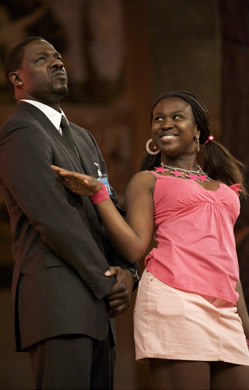
Nicholas Beveney as Marcus and Naana Agyei-Ampadu in Che Walker's The Frontline at Shakespeare's Globe Photo by Manuel Harlan
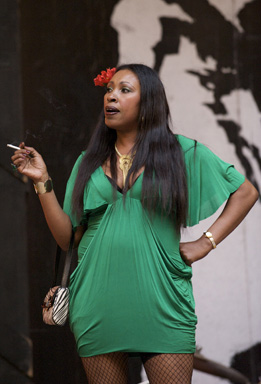
Equal praise goes to multi-talented Jo Martin as Marcus’ adamant, sometimes singing pursuer Violet. It’s not clear what Violet’s actual profession is, but judging by her scanty dress, stilettos with leather straps up to the knees, and her penchant for hanging out by a neon sign saying ‘Fantasy Bar’ it’s clear it’s not kosher.
Jo Martin as Violet in Che Walker's The Frontline at Shakespeare's Globe Photo by Manuel Harlan
Which, brings me to another point - I’ve never seen any places like the ‘Fantasy Bar ’ anywhere near Camden Town tube station, though that might just be due to the fact that given the endless stream of eye level stimulus there, I’m simply not in the habit of looking up, above the colourful store-fronts and crowd, or down, below them. In any event, it’s a given that such places exist all over London, even in our allegedly liberated age, so the effect is still sufficiently generic to be believable. The stage has been enhanced for this production and boasts ramps extending from front and, centre, expanding both left and right to add to the performance area. And, in keeping with the urban setting of the play, the theatre’s two trademark onstage oaken pillars have been covered with black bin liner material. Identical Banksy inspired drawings of a little girl holding a balloon which, appear to have been spray painted on opposite sides of the backdrop, along with the proverbial ‘Underground’ sign complete this gritty landscape, designed by Paul Wills, who also designed the set for We the People at the Globe in 2007. Cultural references abound in this production as well, with Trystan Gravell portraying an obviously Withnaillian (inspired by Richard E. Grant in Withnail & I) desperate actor chap named Mordechri Thurrock, who reappears throughout the play in order to make yet another desperate phone call to potential producers, during which he neurotically extols the merits of his acting. While overblown and over-used, Gravell’s appearances wear a bit thin in time, though they are nonetheless, comic. Ashley Rolfe also does a lively turn as Elliot the archetypal teenager falling in with the wrong crowd. In keeping with the Globe’s practices on musicians, an ‘unplugged’ trio (apart from electric guitar on one number) back up the vocals on songs, on songs ranging from traditional spirituals and Blues to rock, ska and reggae influenced numbers, most of them composed by Olly Fox especially for this production. The characters generally do not burst into song at any and all opportune moments as they might in the case of vintage cinematic musicals, so the effect is usually pleasant rather than grating. However, it must be said that songs in a show with so much potentially pressing subtext basically seem to be ‘out there on their own,’ in that they sometimes tend to detract rather than add to the production’s overall impact. Still and all, it has to be said that songs like the show’s opening number, ‘Invisible People’ have valid points to make and they make them well. ‘I am fascinated by what happens around stations,’ stated playwright and long term Camdenite Walker to queries about the inspiration for his play, There is usually skulduggery, drug trafficking, prostitution, lost people arriving, drifting, on their way somewhere.’ While The Frontline does manage to capture a bit of the flavour of some of these themes, it does so in a way that is more akin to our contemporary habit of capturing and, consuming bites of information, rather than in a way that is savour worthy or, truly captivating.
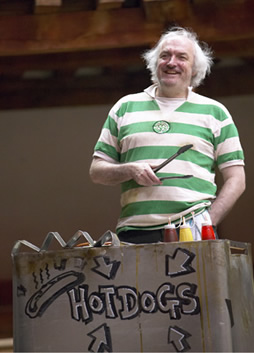
The narrator of Che Walker's The Frontline at Shakespeare's Globe Photo by Manuel Harlan
Shakespeare's Globe Telephone: +44 (0)20 7401 9919 http://www.shakespeares-globe.org Tickets: £5 - £30
Copyright © EXTRA! EXTRA All rights reserved
|