Reviewers
Allan McKeown and Sarah Gregson in association with Neil McPherson for the Finborough Theatre present
Michael Craig and Meghan Popiel
in
The UK Premiere
Trying
by Joanna McClelland Glass
Directed by Derek Bond
Designed by James Perkins
Lighting Design by Sally Ferguson
Sound Design by Kathryn Wilson
Finborough Theatre
17 March – 11 April 2009
 ary Couzens ary Couzens
A review by Mary Couzens for EXTRA! EXTRA!
This enjoyable, finely tuned production offers everything an intelligent theatre goer could wish for: a strong witty script, consummate acting, smooth attentive directing, sets reeking with character, atmospheric, time reflecting sound design and sensitive lighting.
The premise of this play is, in its own right an intriguing one – an elderly, retired judge who struggles against fluctuating senility, finally learns to rise above the bad habits of a lifetime and respect the new young secretary his wife has hired for him, as opposed to intimidating her. Add the fact that the action is set in the judge’s ‘final year’, 1968, a revolutionary year around the world, during which Dr. Martin Luther King and Robert Kennedy were assassinated and American women were ‘burning their upper undergarments’ as the judge tactfully put it, and, and you have a play, as generated by the observant eyes, ears and hands of Joanna McClelland Glass, the real Judge Biddle’s secretary, which has much to offer. In relation to this winning little production, terms, of the superlative kind, would actually be insufficient to describe its many merits! If you go and see it, you’ll quickly understand why.
The historical context of this play, as it relates to Judge Biddle’s own personal timeline is also a fascinating one. Born in 1886 in Paris, while his family was living abroad, Biddle was related to both Edmund Randolph (1753-1813), the first Attorney General of the United States, (a post he himself would assume under Franklin Delano Roosevelt in 1941), and, more distantly, James Madison, the country’s fourth president. To his credit, Biddle threw off his family’s long revered Republican mantle in favour of becoming a Democrat after his observations of the plight of Pennsylvania’s Coal Miners in the Depression years. However, during his lifetime, Judge Biddle was perhaps, best known for his appointment to the International Military Tribunals at Nuremberg by President Harry Truman in 1945. In hindsight, he is also known for instigating the F.B.I.’s arrest of ‘enemy aliens’ on December 7, 1941, a move which is seen as the ‘precursor’ to the authorization of the notorious Japanese Internment Camps. Following his graduation from Harvard (with two degrees) in 1911, Biddle had worked as private secretary to Supreme Court Judge Oliver Wendell Holmes, Jr., and practiced law in Philadelphia for twenty-seven years before becoming a judge himself. He was also a voracious writer and all round character to be reckoned with, who was married, for life to poet Katherine Garrison Chaplin, a well regarded writer whose work was set to orchestral music many times and even once performed by the great Paul Robeson. However, ‘Katherine’, as her absent character is simply referred to here, is, for the purposes of this play, little more than a much referenced presence in the judge’s conversations and a voice we cannot hear on the telephone on Judge Biddle’s desk, which is often responded to by Michael Craig, the actor portraying him, with comically vehement dismay.
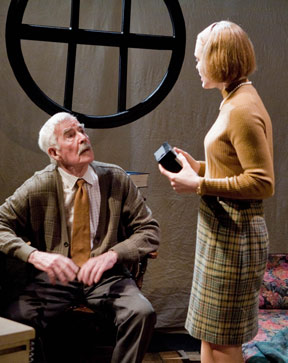
Watching master actor Michael Craig, who has come out of theatrical retirement to star in this gem, is, quite simply, a dream. Mr. Craig’s timing is superlative, and, his ability to inhabit the skin of his character is inspired. The character he plays, Judge Francis Biddle is cantankerous and infuriating, and yet, extremely likeable as Mr. Craig plays him, which is some feat, considering the judge’s insultingly sexist rhetoric and reputation for being difficult. The opening action finds his ‘non-ivy league’ Canadian secretary, hired for him by his wife, Katherine, first meeting her illustrious American employer in his cluttered Georgetown, Washington D.C. office, above his garage, with him advising her where the bathroom is, in case she needs to go have ‘a good cry’. In the past, Biddle has always favoured middle aged women as co-workers, but as his health and mental capacities are progressively dwindling, he has had no say in the hiring of this particular secretary. Her chief purpose, as instructed by his wife, is to help the Judge get his office/legacy in order. The ensuing power struggles between the pair, ultimately intended for the judge’s own good, are made all the stronger by the young woman’s unexpected tenacity and strength, which, eventually reveals the judge’s inner compassion, confirming a dynamic that we are all guilty of, that of acting on habit, rather than true feeling. As the judge himself said, ‘One’s eyes are what one is, one’s mouth what one becomes.’
The fact that Michael Craig has been out of the public’s eye, at least the British public’s eye for some time, apart from perhaps, his many roles in films over the years, is actually an asset of sorts. For, not only does his seeming anonymity serve his character well, but it leaves one with the distinctly pleasurable feeling of having unearthed a bona fide theatrical treasure right here, in the heart of London’s fringe theatre-land. I know you’re eighty Mr. Craig, but please don’t use that as an excuse to stay away from London’s stages, even though you are rightfully, a star in Australia where you reside. The stages of this city are crying out for the inimitable likes of you, eighty or no! Actress Meghan Popiel in the role of Sarah Schoor, Judge Biddle’s determined, twenty-five year old secretary, holds her own against the masterful Mr. Craig in terms of acting, just as she is meant to do with her boss, Judge Biddle’s character. Ms. Popiel gives an alternately warm, intelligent, funny and touching performance which is quite memorable in its own right. Thanks to both actors for their excellent performances, and also, to Derek Bond for his thoughtful directing.
The production’s lived in looking set, designed by James Perkins, with its filled bookcases, desk piled with papers, temperamental electric heater, coffee table and petite secretary’s desk, complete with compact plastic typewriter and princess phone is something of a marvel, particularly for the way it seems to take up residence in the Finborough’s small, but always well employed performance space. Kathryn Wilson’s relevant sound design puts us right where we should be, with rousing fragments of Dr. Martin Luther King’s ‘I Have a Dream’ speech poignantly cutting through the darkness of the theatre, before the action begins, placing us firmly in 1968, Judge Biddle’s last year. Similarly, snippets of the late Robert Kennedy speaking about his hopes for America should he become president serve as potent reminders of the time, as do bits of ‘Jumping Jack Flash’, ‘Abraham, Martin and John’ and Thunderclap Newman’s seminal late ‘60’s hit, ‘Something in the Air’. Lighting design by Sally Ferguson is similarly thoughtful, as it enhances rather than intrudes.
Are you listening, West End producers? This production features inspiring performances from both of its actors and reeks with socially tinged, gender/era crossing insight about the human condition which couldn’t possibly work as effectively as it does in the hands of lesser performers or, a lesser director, thanks to Derek Bond. So those of you seeking pricey tickets to shows in which sexy stars du jour appear who seduce, more often than not, much better in their newspaper and magazine photos than they do onstage, perhaps a little thought is in order. Fluff can be fun, but a steady diet of it tends to severely damage one’s perception, and subsequently, might encourage a dim view of theatre in general. It’s far too easy to buying into that ‘mainstream is cool’ way of thinking. And anyway, after all that’s said and done, Trying is coming back in.
Box Office 0844 847 1652
Book online at http://www.finboroughtheatre.co.uk
Finborough Theatre, The Finborough, 118 Finborough Road, London SW10 9ED
Tuesday to Saturday Evenings at 7.30pm.
Sunday Matinees at 3.00pm.
Saturday Matinees at 3.00pm (from 28 March).
Tickets £13, £9 concessions, except Tuesday Evenings £9 all seats, and
Saturday evenings £13 all seats.
Previews (17 March and 18 March April) £9 all seats.
EXTRA! EXTRA! www.extraextra.org
Copyright © EXTRA! EXTRA All rights reserved
Home
Reviewers
|